

In a fast-paced urban environment, prioritizing wellness before illness strikes is the smartest investment you can make in your longevity.
Choosing the right preventive health checkup packages allows individuals and families to take control of their health before subtle metabolic shifts turn into chronic conditions. Whether you are managing desk-job fatigue or planning an annual wellness review, visiting an advanced health screening centre in Bangalore transforms traditional, reactive healthcare into an empowering, proactive strategy designed to protect your long-term vitality.
Modern lifestyle factors such as prolonged sedentary screen time, irregular sleep cycles, chronic stress, and processed diets have significantly accelerated the onset of non-communicable diseases. The greatest challenge with these conditions is their silent progression:
- The Silent Killers: Early-stage fatty liver (NAFLD), insulin resistance, borderline hypertension, dyslipidemia, and localized early neoplasms rarely cause overt pain or physical warning signs.
- The Cost of Delay: Waiting for symptoms to manifest often means discovering a condition only after it has caused vascular damage, organ strain, or advanced structural change.
- The Power of Early Baseline Audits: Routine biomarker profiling detects micro-deficiencies, hormonal imbalances, and cellular risk markers at reversible stages, allowing for timely dietary, lifestyle, or medical course corrections.
Rather than viewing a health checkup as an inconvenient chore done only when feeling sick, proactive screening functions as a regular internal health audit giving you clear, actionable data about your heart, liver, kidneys, and metabolic wellness.
What You Will Discover in This Guide
- Personalizing Your Health Audit: How to match screening parameters to your age, gender, occupational habits, and family history.
- Decoding Package Tiers: Understanding what basic, advanced, and comprehensive full-body packages actually include.
- The 4 Core Diagnostic Pillars: Essential tests every health assessment must cover (metabolic, organ function, micronutrients, and chronic risk flags).
- Choosing the Right Diagnostic Facility: Quality checklists covering lab precision, digital reporting speed, and doctor-led report interpretation.
We believe health care should focus on health preservation, not just disease management. Equipped with advanced diagnostic pathology and imaging technologies, our goal is to deliver transparent, comprehensive, and hassle-free screening packages that give you a complete picture of your health.
Medical & Diagnostic Disclaimer
The information, package recommendations, and clinical testing guidelines presented in this article are intended strictly for educational, informational, and public health awareness purposes. They do not constitute formal medical advice, clinical diagnosis, or a personalized treatment plan. Health parameters, screening frequency, and diagnostic investigations should always be determined in consultation with a qualified physician or healthcare provider based on individual clinical evaluation.
Personalizing Your Health Audit: Age, Gender & Lifestyle Triggers

A standard, one-size-fits-all health checkup rarely delivers the precise answers your body needs. A 25-year-old software engineer dealing with irregular sleep and desk-bound fatigue requires a very different diagnostic focus than a 55-year-old managing fluctuating blood pressure and joint stiffness.
Tailoring your preventive health screening to your specific life stage, gender, and daily habits ensures you track the biomarkers that matter most, avoiding unnecessary tests while catching hidden risks early.
Age-Decade Screening Matrix
| Life Stage | Core Physiological Vulnerabilities | Essential Screening Parameters |
|---|---|---|
| In Your 20s & 30s (Early Career & Desk Lifestyles) | Sedentary screen hours, erratic meal timings, high caffeine intake, chronic burnout. | 1. Fasting Glucose & HbA1c (Insulin Resistance) 2. Vitamin D3 & Vitamin B12 Levels 3. Complete Lipid Profile (Triglycerides & Cholesterol) 4. Baseline Liver Function (Fatty Liver Index) |
| In Your 30s & 40s (Mid-Career & Hormonal Shifts) | Slowing baseline metabolic rate, early vascular stiffness, visceral fat accumulation, stress-induced hormonal fluctuations. | 1. Extended Cardiac Risk Panel (hs-CRP, ApoB, ECG) 2. Complete Thyroid Profile (Free T3, Free T4, TSH) 3. Kidney Function Tests (Serum Creatinine, eGFR, Uric Acid) 4. Ultrasound Abdomen & Pelvis (Visceral Organs) |
| In Your 50s & Beyond (Active Longevity & Senior Wellness) | Progressive bone demineralization, decreased renal filtration, arterial plaque buildup, age-related cellular risks. | 1. Advanced Cardiovascular Profiling & Treadmill Stress Test (TMT) 2. Bone Mineral Density (DEXA Scan) & Calcium/Phosphorus 3. Complete Renal & Liver Filtration Panels 4. Organ-Specific Baseline Oncological Screening |
Gender-Specific Health Parameters
Biological differences dictate distinct screening priorities across different decades of life:
For Women: Hormonal transitions (PCOS, pregnancy, perimenopause, and menopause) influence bone density, iron stores, and endocrine balance.
A comprehensive checkup should incorporate Serum Ferritin/Iron studies, Thyroid antibodies, Pelvic Ultrasonography, and routine gynaecological screenings such as Pap Smears / HPV DNA tests and Digital Mammography / Breast Ultrasound after age 40.
For Men: Visceral fat accumulation and cardiovascular risks tend to accelerate earlier in men. Key parameters include Total & Free Testosterone (when evaluating chronic fatigue or metabolic slowdown), high-sensitivity inflammatory markers, and Prostate-Specific Antigen (PSA) blood testing starting at age 45 to 50 (or age 40 with a family history of prostate disease).
Lifestyle & Genetic Risk Modifiers
Your daily habits and family medical history serve as decisive triggers for expanding your screening scope:
- Sedentary Tech & Desk Work: Extended sitting triggers metabolic syndrome and postural stress. Emphasize micro-nutrient panels (B12, D3), fasting insulin, and inflammatory markers.
- Family History of Cardiac Disease or Diabetes: Mandates early baseline testing starting at age 25, focusing on HbA1c, Apolipoprotein B (ApoB), and Lipoprotein(a) to catch hereditary lipid particle risks that standard cholesterol tests miss.
- Smoking, Alcohol, or Frequent Travel: Requires deeper hepatic evaluation (Gamma-GT, FibroScan/Ultrasound) and low-dose respiratory functional checks.
The most effective health checkup is one designed around your actual risk factors. When choosing a package, evaluate your daily stress, sleep quality, and family tree to ensure your diagnostic panel audits your true vulnerabilities.
Decoding the Packages: Basic vs. Advanced vs. Comprehensive Tiers
Navigating the wide variety of health checkup packages can feel overwhelming without a clear breakdown of what each tier provides.
Diagnostic packages are structured hierarchically starting from foundational blood counts and scaling up to multi-organ metabolic panels and advanced imaging. Understanding these tiers ensures you select a package that fits your personal health profile without overpaying for unnecessary tests or overlooking critical markers.
Package Tier Comparison
| Screening Tier | Target Demographic & Clinical Focus | Core Diagnostic Parameters Included | Primary Clinical Value |
|---|---|---|---|
| Basic Health Package | Young adults (20s), first-time checkup visitors, or low-risk baseline health tracking. | • Complete Blood Count (CBC) & Urine Analysis • Liver Function Test (LFT) & Kidney Function (KFT) • Fasting Blood Sugar & Total Cholesterol • Thyroid Stimulating Hormone (TSH) | Establishes a fundamental baseline for vital organ function, identifying early anemia, asymptomatic kidney strain, or elevated fasting glucose. |
| Advanced / Lifestyle Package | Desk-bound professionals, individuals with chronic fatigue, or mild metabolic risks. | • All Basic Tests plus: • Complete Lipid Profile (LDL, HDL, VLDL, Triglycerides) • Glycated Hemoglobin (HbA1c – 3-Month Glucose) • Vitamin D3 & Vitamin B12 Levels • High-Sensitivity C-Reactive Protein (hs-CRP) | Audits lifestyle stress, micronutrient depletion, systemic low-grade inflammation, and early insulin resistance. |
| Comprehensive / Executive Package | Adults aged 40+, individuals with family histories of diabetes or heart disease, and seniors. | • All Advanced Tests plus: • Ultrasound Abdomen & Pelvis (Fatty Liver, Gallstones) • Resting ECG & Cardiac Risk Markers (ApoB/Lipoprotein-a) • Complete Iron Profile & Electrolyte Balance • Age-Specific Markers (PSA for Men / Mammography & Pap for Women) | Delivers a deep, multi-organ evaluation to uncover structural organ changes, visceral fat accumulation, and silent cardiovascular plaque risks. |
How to Select the Right Tier Without Overspending
- Avoid Parameter Padding: Some checkup catalogs inflate test counts by splitting a single panel (such as a 12-parameter liver profile) into individual line items. Focus on the categories covered organ function, metabolic control, and micronutrients rather than raw test numbers.
- Decide on Imaging Upfront: Blood-only packages provide deep metabolic insight at an accessible price point. If you require abdominal ultrasounds, ECGs, or chest X-rays to assess physical organ structures, upgrading to a comprehensive imaging-inclusive tier is the most cost-effective approach.
- Establish an Annual Routine: Scheduling a consistent annual health screening using an appropriately matched tier creates a continuous health record, allowing doctors to spot subtle year-over-year biomarker trends before they cross clinical thresholds.
The Smart Selection Rule: Choose the package that matches your lifestyle and family health history rather than simply purchasing the largest available panel. A targeted diagnostic audit tailored to your actual vulnerabilities delivers far greater clinical value than an unfocused set of random tests.
The 4 Core Diagnostic Pillars: What Every Complete Checkup Must Cover
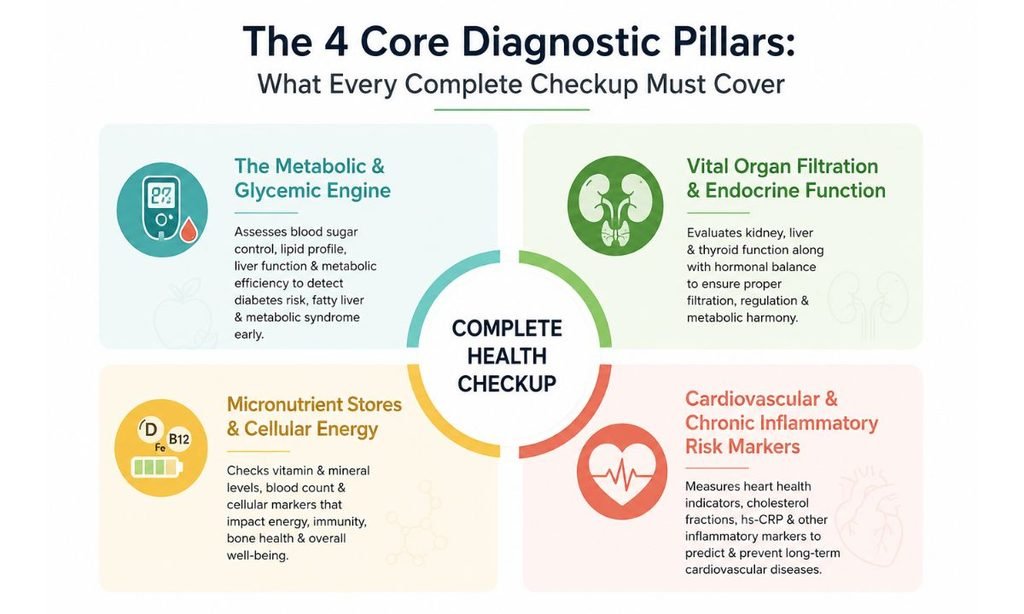
A truly effective health audit is not just a random collection of blood tests; it is a systematic assessment of four interconnected biological pillars.
In modern preventive healthcare, evaluating these four clinical domains provides a complete picture of your internal physiological balance, pinpointing subtle metabolic stress, organ strain, and nutritional deficiencies before they cause noticeable symptoms.
1. The Metabolic & Glycemic Engine
Metabolic health governs how efficiently your body converts food into energy and regulates cellular fuel. A comprehensive panel looks beyond basic fasting sugar:
- Fasting Blood Glucose & HbA1c: While a fasting glucose test captures a single snapshot in time, Glycated Hemoglobin (HbA1c) measures your average blood sugar over the preceding 90 days. This reveals early pre-diabetes and insulin resistance years before clinical symptoms develop.
- Comprehensive Lipid Panel: Evaluates Total Cholesterol, High-Density Lipoprotein (HDL – protective cholesterol), Low-Density Lipoprotein (LDL), and Triglycerides. The Triglyceride-to-HDL ratio serves as a vital clinical marker for assessing visceral adiposity and cardiovascular risk.
2. Vital Organ Filtration & Endocrine Function
Your liver, kidneys, and thyroid gland are the body’s primary metabolic processing and filtration engines. Routine screening tracks their baseline efficiency:
- Liver Function Tests (LFT): Measures hepatic enzymes (SGOT/AST, SGPT/ALT, Alkaline Phosphatase) and total protein/bilirubin. Elevated liver enzymes often serve as the earliest indicator of non-alcoholic fatty liver disease (NAFLD) or toxic lifestyle stress.
- Kidney Function Tests (KFT / RFT): Evaluates Serum Creatinine, Blood Urea Nitrogen (BUN), Uric Acid, and estimated Glomerular Filtration Rate (eGFR) to confirm optimal renal blood filtration and identify early microvascular strain.
- Complete Thyroid Panel (TSH, Free T3, Free T4): Audits the master gland governing energy metabolism, body temperature, and weight management, uncovering subclinical hypothyroidism or hyperthyroidism.
3. Micronutrient Stores & Cellular Energy
Urban indoor lifestyles and modern dietary habits frequently lead to silent micronutrient deficiencies that drain daily vitality:
- Vitamin D3: Essential for calcium absorption, bone mineral density, neuromuscular health, and immune system modulation. Over 70% of urban professionals have severe subclinical Vitamin D depletion.
- Vitamin B12: Critical for nerve myelin sheath maintenance, cognitive performance, and red blood cell production. Deficiencies often manifest as unexplained brain fog, morning fatigue, and peripheral tingling.
- Complete Iron & Ferritin Profile: Measures not just circulating hemoglobin, but your body’s deep bone marrow iron reserves (Ferritin), identifying occult iron deficiency before full anemia sets in.
4. Cardiovascular & Chronic Inflammatory Risk Markers
Chronic low-grade inflammation within the vascular endothelium is the underlying driver of arterial stiffening, atherosclerosis, and long-term cardiovascular disease:
- High-Sensitivity C-Reactive Protein (hs-CRP): A sensitive blood marker that detects microscopic inflammation in arterial walls, offering predictive value for future cardiac events even when cholesterol numbers look standard.
- Complete Blood Count (CBC) & ESR: Assesses red cell morphology, platelet counts, and white cell differential to identify hidden chronic infections, bone marrow shifts, or immune imbalances.
- Routine Urinalysis: Screens for microscopic protein leakage (microalbuminuria), glucose excretion, or red blood cells, providing an immediate early warning of glomerular stress.
| Diagnostic Pillar | Primary Health Value |
|---|---|
| 1. Metabolic Engine | Uncovers early insulin resistance and dyslipidemia |
| 2. Organ Function | Tracks liver filtration, kidney eGFR & thyroid |
| 3. Micronutrients | Restores energy by auditing D3, B12, & Ferritin |
| 4. Vascular Markers | Identifies silent inflammation via hs-CRP & CBC |
When all four pillars are evaluated together, doctors can connect the dots between seemingly unrelated complaints such as linking low energy to borderline thyroid levels paired with low Vitamin D3 and elevated hs-CRP creating a clear path for targeted wellness interventions.
Evaluating Diagnostic Quality: Checklist for Choosing a Centre in Bangalore
Bengaluru is home to a vast network of clinical laboratories, diagnostic chains, and imaging centres. However, the true value of your health screening depends entirely on the accuracy of the laboratory processing your blood and the clinical depth of the physicians interpreting your results.
When scheduling a comprehensive Full Body Checkup in Bangalore, using an objective quality checklist ensures you receive clinically valid data rather than automated, unverified laboratory numbers.
The 5-Point Diagnostic Quality Checklist
| Checklist for Selecting a Diagnostic Centre |
|---|
| 1. Laboratory Accreditation & Automated Quality Control (NABL/CAP) |
| 2. Pre-Test Guidance & Fasting Protocol Support |
| 3. Transparent Pricing with No Hidden Surcharges |
| 4. Same-Day Digital Report Turnaround via Secure Portals |
| 5. Doctor-Led Consultation to Translate Numbers into Action Plans |
1. Laboratory Precision & Quality Standards
Diagnostic accuracy begins with automated, calibrated analyzers:
- Standardized Quality Controls: High-quality centres run daily multi-level internal quality control (IQC) and participate in external quality assessment schemes (EQAS) to prevent calibration drift.
- Cold-Chain Sample Integrity: For home blood collection or multi-centre sample routing, blood samples must be transported in temperature-controlled cold-chain containers to prevent in-vitro hemolysis, which can falsely elevate potassium or liver enzyme readings.
2. Pre-Test Preparation & Clear Instructions
Accurate biomarker measurement requires clear pre-test instructions before you arrive at the facility:
- Fasting Window: A strict 10 to 12-hour overnight fast is required for accurate fasting blood glucose and lipid panel (triglyceride) assessment. Drinking plain water is encouraged to prevent dehydration, which can artificially concentrate blood parameters.
- Medication Guidelines: Clear instructions on whether to take or pause daily thyroid medications or antihypertensives on the morning of blood collection.
- Lifestyle Timing: Advising patients to avoid strenuous exercise, heavy alcohol intake, and high-fat meals for 24 hours prior to blood draws, as these activities can temporarily distort liver enzymes and uric acid levels.
3. Transparent Reporting & Doctor-Led Consultations
A raw laboratory report filled with numbers and reference ranges is only half the service. The most critical step is clinical translation:
- Doctor Review Included: A quality diagnostic centre pairs your report with a medical consultation to explain what borderline values mean in the context of your daily lifestyle, diet, and symptoms.
- Actionable Next Steps: Rather than leaving you to search online about an out-of-range value, a doctor provides clear dietary, lifestyle, or medical recommendations.
- No Hidden Charges: Pricing for complete packages, including sample collection and consultation, should be clear and upfront.
Red Flags to Avoid When Booking a Checkup
- Unverified Aggregators Without Physical Labs: Platforms that outsource samples to unaccredited, third-party basement facilities without quality oversight.
- Inflated Parameter Counts: Facilities that split routine complete blood counts into 20 separate line items to make a basic package appear larger than it is.
- Lack of Physician Oversight: Reports delivered without any clinical review or option to speak with a medical professional.
The Quality Benchmark: A diagnostic report is only as useful as its clinical accuracy. Choosing an accredited facility with automated processing and doctor-led review ensures your preventive checkup provides a reliable foundation for your health decisions.
Why Choose Koshikaa? Proactive Care at The Koshikaa
Preventive healthcare is most powerful when it is accessible, scientifically rigorous, and focused on empowering individuals to take ownership of their health. At The Koshikaa, we have reimagined the health checkup experience moving away from clinical anxiety and crowded waiting rooms toward a comfortable, transparent, and patient-first wellness journey.
As a dedicated diagnostic centre Bangalore residents trust for comprehensive health audits and early disease screening, The Koshikaa integrates automated laboratory pathology, digital imaging, and physician-led report translation under one roof.
The Koshikaa Preventive Care Advantage
- Advanced Laboratory Automation: Fully automated, calibrated analyzers for biochemistry, hematology, immunology, and endocrinology, ensuring error-free biomarker quantification.
- Comprehensive Organ & Cancer Screening: Tailored screening suites that integrate essential blood profiles with vital ultrasound imaging, digital mammography, low-dose CT, and Pap/HPV screening.
- Doctor-Led Report Translation: You never have to interpret complex lab values alone. Every checkup includes a post-report consultation with a physician who translates your data into actionable dietary, lifestyle, and medical steps.
- Zero-Friction Experience: Fast, seamless sample processing, minimal wait times, comfortable centre environments, and same-day digital report delivery via secure portals.
- Transparent Package Architecture: Clear, upfront pricing with no hidden charges, test-count inflation, or unneeded add-ons.
Selecting Your Koshikaa Health Package
| Package Tier | Best Suited For |
|---|---|
| Essential Health Screening | Young adults seeking an accurate annual baseline of vital organ function, sugar, and blood counts |
| Advanced Lifestyle & Metabolic Panel | Desk professionals managing fatigue, stress, vitamin deficiencies (D3/B12), and inflammation |
| Master Executive Health Audit | Adults 40+ requiring multi-organ ultrasound, advanced cardiac risk markers, and organ health |
| Specialized Early Cancer Screening | High-risk groups and seniors prioritizing early organ, breast, cervical, colon, or lung checks |
Conclusion
Investing in an annual health checkup is the most reliable way to stay ahead of silent metabolic shifts, cardiovascular risks, and nutritional imbalances. By selecting a package tailored to your life stage, personal habits, and family history, you gain clear, objective data that removes guesswork from your daily health decisions. Proactive prevention protects your vitality, supports your loved ones, and ensures you remain active and resilient for years to come.
Schedule Your Preventive Health Checkup at The Koshikaa
Take a proactive step toward your long-term health today. Book an appointment for yourself or your family at Koshikaa:
- Location: Bengaluru, Karnataka
- Website: koshikaa.com
Inquiries & Appointments: Visit our official website to select your package, choose a preferred time slot, or arrange home sample collection.