
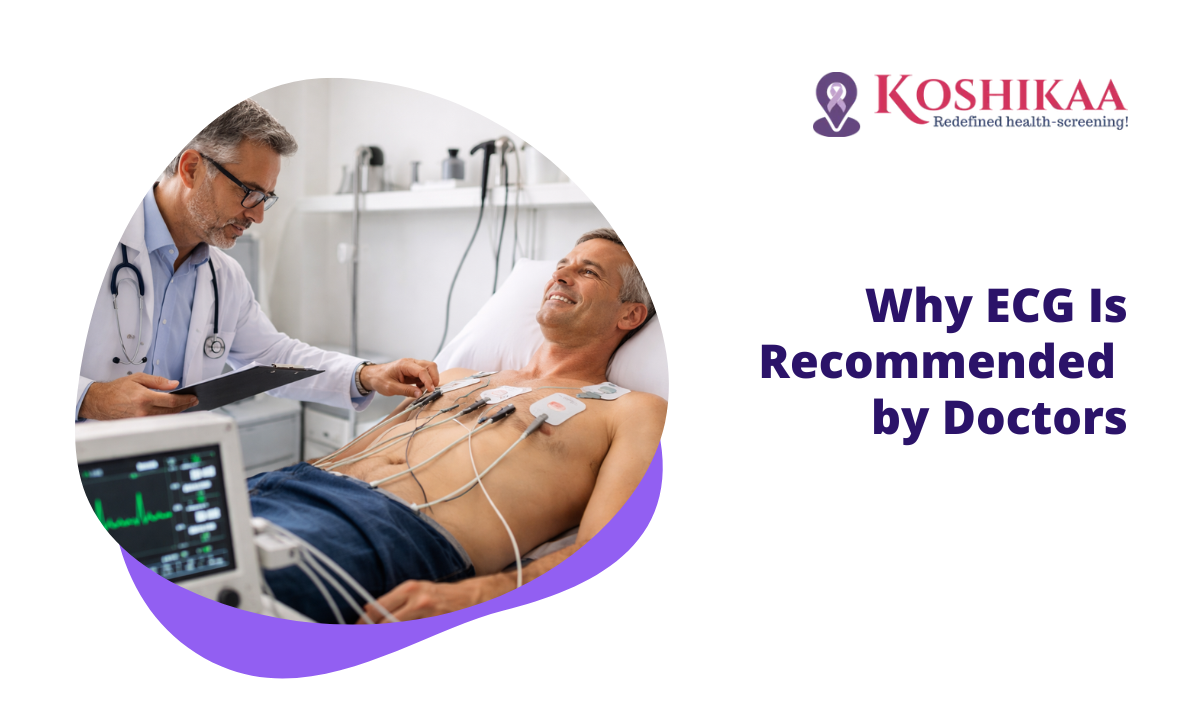
Why Do Doctors Recommend An ECG Test?

Table of Contents

You walk into a clinic for a routine check-up or perhaps for a nagging cough, and suddenly your doctor hands you a prescription for an ECG test. Panic sets in. “Is something wrong with my heart?” “Am I having a silent heart attack?”

Relax. While it is natural to feel anxious, an Electrocardiogram test (ECG) is rarely a sign of immediate doom.

In fact, it is one of the most common and safest diagnostic tools in modern medicine. Think of it as a “dashboard check” for your body’s engine.

Just because the “Check Engine” light flickers doesn’t mean the car is broken; it just means we need to look under the hood.

Understanding why doctors recommend ECG can turn that anxiety into action.

Whether it is to investigate a specific symptom or just to establish a baseline for your health, this simple 10-minute test provides a wealth of information about your heart’s electrical health.

We believe that knowing why you are being tested is just as important as the test itself. Let’s decode the reasons behind this common prescription.

Reason 1: Symptoms You Can Feel

Ruling out the dangerous stuff first.

The most obvious reason a doctor orders an ECG test is that you mentioned a specific symptom that could be heart-related.

The heart is a master of disguise. Its warning signs often mimic other, less serious conditions like indigestion or anxiety.

1. Chest Pain (Angina vs. Acid Reflux) In India, “Gas” is the most common self-diagnosis. But clinically, burning or tightness in the chest can also be Angina (reduced blood flow to the heart).

  • The ECG Role: It helps the doctor quickly differentiate. If the ECG shows “ST-segment changes,” it is likely the heart. If the ECG is normal, it might indeed be just acidity.

2. Palpitations (Fluttering) Have you ever felt like your heart “skipped a beat” or is racing like a galloping horse while you are just sitting on the couch? This is called Palpitations.

  • The ECG Role: It captures the electrical rhythm to see if you have an Arrhythmia (irregular heartbeat) like Atrial Fibrillation.

3. Unexplained Dizziness or Fainting If you feel lightheaded when standing up or have actually fainted (Syncope), it might mean your heart rate is dropping too low (Bradycardia) to pump blood to your brain.

It checks if your natural pacemaker (SA Node) is firing correctly.

Reason 2: Preventive Checks

Why do you need an ECG even if you feel fine?

Sometimes, the danger isn’t what you feel; it’s what you don’t feel.

Doctors often recommend an ECG as part of an annual check-up at a Health screening centre in Bangalore, especially for patients over 30.

This is because certain “lifestyle diseases” quietly damage the heart structure over the years before a single symptom appears.

The Silent Saboteurs:

The ConditionHow it Affects the HeartWhat the ECG Sees
High Blood Pressure (Hypertension)Your heart has to push harder against high pressure. Over time, the heart muscle thickens (gets bulky) to cope.Left Ventricular Hypertrophy (LVH): The electrical waves look taller because the muscle is bigger.
DiabetesHigh sugar damages blood vessels and nerves. Diabetics often suffer “Silent Ischemia” (heart attacks with no pain).ST-T Changes: Subtle shifts in the wave pattern indicate poor blood flow, even without chest pain.
Family HistoryGenetics play a huge role. If your parents had heart issues young age, you are at a higher risk.Baseline Anomalies: Doctors look for inherited rhythm disorders like Long QT Syndrome.

Even if your ECG is normal today, that is valuable! It gives your doctor a “Normal Value” baseline.

If you have chest pain 5 years later, they can compare the new ECG to the old one. If the lines have changed, they know the problem is new and acute.

Reason 3: The Pre-Game Check (Surgery & Fitness)

Clearance for the big events.

An ECG isn’t always about finding disease; sometimes, it’s about ensuring safety before a major physical stress.

1. Pre-Operative Clearance Before almost any surgery (even something unrelated to the heart, like a knee replacement or gallbladder removal), an anesthetist will demand an ECG.

  • Why: General anesthesia slows down your body functions. The doctors need to know your heart is strong enough to handle the anesthesia and wake up safely.

In fitness-conscious cities like Bangalore, many gyms and marathon organizers now advise an ECG before starting intense training.

Intense cardio puts sudden stress on the heart. If you have a hidden condition (like Hypertrophic Cardiomyopathy), heavy lifting or sprinting could trigger a dangerous rhythm. An ECG clears you for safe training.

What is a “Normal” Result?

Patients often anxiously search for ECG test normal value.

  • The Reality: There is no single number. A normal ECG shows a “Sinus Rhythm” (regular beat) between 60–100 beats per minute, with all waves (P, QRS, T) in the right order and size. Anything deviating from this pattern requires a closer look.

Where to Get Tested?

High-quality diagnostics without the stress.

If your doctor recommends an ECG, your first thought might be, “I don’t have time to go to the hospital.” This is a valid concern in a city like Bangalore.

Taking half a day off work for a 10-minute test feels inefficient. Fortunately, technology has evolved. You no longer need a massive hospital machine to get an accurate reading.

Option 1: Clinical Labs & Hospitals

  • Pros: Immediate doctor consultation if something is wrong.
  • Cons: High waiting times, risk of hospital-acquired infections, and the stress of travel.

Option 2: ECG Test at Home in Bangalore

The technician comes to you. You lie in your own bed (which often gives a more accurate “resting” heart rate because you are relaxed).

Services like Koshikaa use FDA-approved portable ECG devices that are clinically equivalent to hospital systems.

  • Cost: Surprisingly, the cost difference is minimal. The cost of an ECG test in India is generally low (ranging from ₹300 to ₹800 in labs), and home services usually charge a small convenience fee on top, making it highly affordable.

Koshikaa Promise: Our ECG services in Bangalore are designed for your comfort. Whether it’s for your elderly parents who can’t travel or for your own peace of mind, we bring the Health screening centre in Bangalore experience to your living room.

Conclusion

When a doctor recommends an ECG, they aren’t trying to scare you. They are trying to shield you. They are using one of the most reliable tools in medical history to ensure your heart is beating exactly as it should.

  • If you have symptoms, it gives you answers.
  • If you are healthy, it gives you a baseline.
  • If you are preparing for surgery or the gym, it gives you safety.

So, the next time you see “ECG” on your prescription pad, don’t panic.

See it as a proactive step towards a longer, healthier life. And remember, with modern home healthcare, checking your heart is now as easy as ordering groceries.

Don’t skip the check. Book your ECG today.

MRI of the uterus is primarily used for diagnosing and evaluating conditions such as uterine fibroids, adenomyosis, and malignancies. It is particularly useful in the planning of surgical procedures and assessing the extent of gynecological diseases. This imaging test is valuable for its ability to deliver detailed cross-sectional images of the uterus and surrounding structures.
An MRI of the spleen can help diagnose various disorders affecting the spleen including splenomegaly (enlarged spleen), tumors, and other abnormalities. It provides clear, detailed images that are crucial for assessing the health of the spleen and planning potential surgical interventions.
Prostate MRI is a non-invasive imaging technique that provides detailed pictures of the prostate gland and surrounding tissues. It helps in the detection, staging, and monitoring of prostate cancer. Prostate MRIs are increasingly used to guide biopsy procedures and assist in the planning of treatment strategies for prostate health.
An MRI of the pancreas is used to identify issues such as pancreatitis, pancreatic cancer, and other pancreatic disorders. It offers high-resolution images that help in detecting small lesions and assessing the pancreatic ducts. This imaging technique is valuable for guiding biopsies and planning surgeries involving the pancreas.
MRI scans of the liver, kidney, and bile ducts provide detailed images that help diagnose various conditions, such as tumors, cysts, and blockages in the bile ducts. They are crucial for assessing organ damage, staging cancer, and planning liver or kidney-related surgeries. This type of MRI can also evaluate the health and function of these organs comprehensively.
Breast MRI is highly sensitive for detecting breast cancer, especially in individuals with dense breast tissue or a high risk of cancer. It is often used in conjunction with mammography to provide a more comprehensive evaluation. Breast MRIs can also monitor the response to breast cancer treatments and provide detailed pre-surgical mapping.
Brain and spine MRIs are critical tools for diagnosing and monitoring neurological conditions, including tumors, spinal cord injuries, and multiple sclerosis. These MRIs can reveal abnormalities in brain tissue and spinal cord structure that might not be visible with other imaging methods. They are essential for planning surgeries and assessing the effectiveness of treatments in neurology.
PET-CT scans of transplant organs like the liver, kidney, or pancreas are performed to assess metabolic activity, detect complications, and monitor post-transplant function. These scans play a vital role in the early detection of issues such as organ rejection, recurrence of disease, or infection, guiding timely interventions and optimizing transplant outcomes for patients.
PET-CT examinations of organs such as the liver, kidney, or prostate are crucial for assessing metabolic activity, detecting abnormalities, and monitoring disease progression. These scans help diagnose conditions such as liver metastases, renal cell carcinoma, or prostate cancer, guiding treatment decisions and monitoring response to therapy over time.
PET-CT scans of soft-tissue masses are utilized to assess metabolic activity and detect malignant tumors or other abnormalities. By combining PET imaging with CT imaging, these scans provide detailed information about tumor location, size, and metabolic characteristics, aiding in accurate diagnosis and treatment planning for soft-tissue cancers.
PET-CT scans are valuable for detecting cysts or fluid collections within the body, including cysts in the liver, kidneys, or other organs. These scans help characterize the nature and metabolic activity of cysts, guiding diagnosis and treatment planning for conditions such as cystic liver disease, renal cysts, or pancreatic cysts.
PET-CT scans of muscles are performed to assess metabolic activity and detect abnormalities such as inflammation, infection, or tumors. These scans provide valuable information about muscle function and pathology, aiding in the diagnosis and management of conditions like myositis, muscular dystrophy, or soft-tissue sarcomas.
PET-CT scans of the brain are utilized to evaluate brain metabolism and detect abnormalities such as tumors, epilepsy, or neurodegenerative diseases. By combining functional PET imaging with anatomical CT imaging, these scans offer comprehensive information about brain function and structure, guiding neurosurgical interventions and treatment decisions for neurological disorders
PET-CT scans of bones are commonly used to detect bone metastases in cancer patients, assess bone health in conditions like osteoporosis, and evaluate response to treatment. By combining PET and CT imaging, these scans provide detailed information about metabolic activity and anatomical changes in bone structures, aiding in accurate diagnosis and treatment planning for various bone-related conditions.
CT scans of the spine are conducted to assess the vertebrae, spinal cord, and surrounding soft tissues for conditions like herniated discs, spinal fractures, or spinal stenosis, aiding in the diagnosis and management of spinal disorders with detailed imaging essential for surgical planning and intervention.
CT scans of the pelvis are utilized to visualize the pelvic bones, reproductive organs, bladder, and surrounding structures for conditions such as fractures, tumors, or pelvic inflammatory disease, guiding treatment plans and surgical interventions with precise anatomical information.
CT scans of the neck are performed to evaluate structures such as the throat, thyroid gland, lymph nodes, and blood vessels for abnormalities like tumors, infections, or injuries, assisting in diagnosis and management of head and neck disorders with detailed imaging.
CT scans of the extremities are employed to assess bones, joints, and soft tissues in the arms or legs, aiding in the diagnosis of fractures, arthritis, or other musculoskeletal conditions, guiding orthopedic treatment and rehabilitation plans for optimal recovery.
CT scans of the chest are utilized to examine the lungs, heart, blood vessels, and surrounding structures for conditions such as lung nodules, pneumonia, or pulmonary embolism, facilitating accurate diagnosis and management of respiratory and cardiovascular diseases.
CT scans of the brain are conducted to assess brain structures, identify abnormalities like tumors, hemorrhages, or strokes, and aid in diagnosing neurological conditions, guiding neurosurgical interventions and treatment strategies with precise imaging of the brain’s anatomy.
CT scans of the abdomen are performed to visualize and evaluate the internal organs such as the liver, kidneys, pancreas, and intestines for conditions like tumors, infections, or injuries, providing detailed images essential for diagnosis and treatment planning.
Transplant organ ultrasound scans, including those of the liver, kidney, or pancreas, are performed to assess organ viability, detect complications, and monitor post-transplant function. These scans play a vital role in the early detection of issues such as organ rejection, vascular complications, or fluid collections, guiding timely interventions and optimizing transplant outcomes for patients.
Ultrasound examinations of organs such as the liver, kidney, or prostate are crucial for assessing organ structure, detecting abnormalities, and monitoring disease progression. These scans help diagnose conditions such as liver cirrhosis, kidney stones, or prostate enlargement, guiding treatment decisions and monitoring response to therapy over time.
Soft-tissue masses can be evaluated using ultrasound to determine their size, location, and characteristics. Ultrasound imaging helps differentiate between benign and malignant masses, guiding further diagnostic evaluation and treatment planning. By providing real-time imaging, ultrasound assists in the precise localization of soft-tissue masses for biopsy or surgical removal if needed.
Ultrasound scans are valuable for detecting cysts or fluid collections within the body, including cysts in the liver, kidneys, or other organs. These scans help characterize the nature and size of cysts, aiding in diagnosis and treatment planning for conditions such as cystic liver disease or renal cysts, and guiding interventions such as cyst drainage or sclerotherapy.
Musculoskeletal ultrasound scans are used to assess the health and integrity of muscles, identifying issues such as strains, tears, or muscle inflammation. These scans provide detailed images of muscle structures, allowing healthcare providers to diagnose muscle injuries accurately and develop personalized rehabilitation plans to promote recovery and restore function.
Ultrasound examinations of joints are essential for evaluating joint health, detecting abnormalities such as inflammation, fluid accumulation, or cartilage damage. By visualizing the joint structures in real-time, ultrasound helps diagnose conditions like arthritis, bursitis, or ligament injuries, guiding treatment decisions and monitoring disease progression over time.
Ultrasound scans of tendons are performed to assess for injuries, inflammation, or tears, aiding in the diagnosis and management of conditions such as tendonitis or tendon tears. These scans provide detailed images of tendon structures, helping healthcare providers determine the extent of damage and plan appropriate treatment strategies, including physical therapy or surgical intervention if necessary.
Pelvis X-rays play a crucial role in diagnosing injuries, diseases, and developmental conditions affecting the pelvic region. They provide detailed images of the hip bones, sacrum, and coccyx, aiding in the assessment of fractures, dislocations, or signs of arthritis. Pelvic X-rays are instrumental in guiding surgical interventions, monitoring healing progress, and evaluating conditions such as osteoporosis or tumors. By providing precise anatomical information, these imaging studies enable healthcare professionals to deliver personalized care and improve patient outcomes.
Teeth X-rays, known as dental radiographs, are indispensable tools for dentists to assess oral health. They aid in diagnosing dental decay, gum disease, and abnormalities in tooth structure or alignment. These images provide valuable insights into hidden dental issues, allowing for early intervention and prevention of complications. Additionally, dental X-rays are essential for planning treatments such as orthodontics, root canals, or dental implants, ensuring optimal outcomes and patient satisfaction.
Spine X-rays are pivotal in diagnosing spinal fractures, degenerative conditions, and spinal misalignments, providing critical information for treatment planning and monitoring spinal health. They offer detailed images of the vertebrae and surrounding structures, enabling healthcare professionals to identify issues such as scoliosis, disc herniation, or spinal stenosis
Skull X-rays are valuable for detecting fractures, assessing head trauma, and evaluating the alignment of facial bones, crucial in diagnosing conditions like fractures, tumors, or developmental abnormalities in the skull. They provide detailed views of the cranial structure, aiding clinicians in determining appropriate treatment strategies and ensuring patient safety.
For the heart, X-ray solutions can aid in the detection of various cardiac problems, ranging from mild to severe, including – Heart failure, Cardiac congestion and other heart-related conditions. In addition to cardiac assessments, X-ray solutions are also used for breast examinations to identify tumors or signs of breast cancer.

Bone X-rays are essential for diagnosing fractures and assessing bone alignment, aiding doctors in developing treatment plans and monitoring healing progress. They provide detailed images of the skeletal system, helping identify abnormalities or injuries that may not be visible through other imaging techniques

Abdominal X-rays are performed when patients experience symptoms such as significant nausea, ongoing vomiting, abdominal pain, flank or back pain, or abdominal swelling. These X-rays can help diagnose various conditions.

Frequently Booked Tests

Frequently Booked Checkups