
An HbA1c test in Bangalore is a blood test used to measure average blood sugar levels over the previous two to three months. It is commonly used to screen for prediabetes and diabetes and to monitor blood sugar control in people who already have diabetes.
Unlike a fasting blood sugar test, an HbA1c test generally does not require fasting. A blood sample is collected and analysed to determine the percentage of haemoglobin that has glucose attached to it.
Koshikaa offers HbA1c testing in Bangalore with lab testing at ₹299 and home sample collection at ₹349. HbA1c is also included in Koshikaa’s Standard and Advanced health checkup packages.
What Is an HbA1c Test?
HbA1c stands for Glycated Haemoglobin or Haemoglobin A1c.
When glucose circulates in the blood, some of it attaches to haemoglobin inside red blood cells. Since red blood cells remain in circulation for several weeks, measuring glycated haemoglobin provides an estimate of average blood glucose over the previous two to three months.
The test is also known as:
- HbA1c test
- Glycated haemoglobin test
- Glycosylated haemoglobin test
- Haemoglobin A1c test
- A1c test
- Average blood sugar test
What Does the HbA1c Test Measure?
The HbA1c test measures the percentage of haemoglobin that has glucose attached to it.
It provides a longer-term view of blood sugar compared with a single fasting or random blood sugar reading.
For example, your blood sugar can change during the day because of:
- Food
- Exercise
- Stress
- Illness
- Medication
- Physical activity
An HbA1c test provides an indication of your average glucose exposure over a much longer period.
HbA1c Normal Range
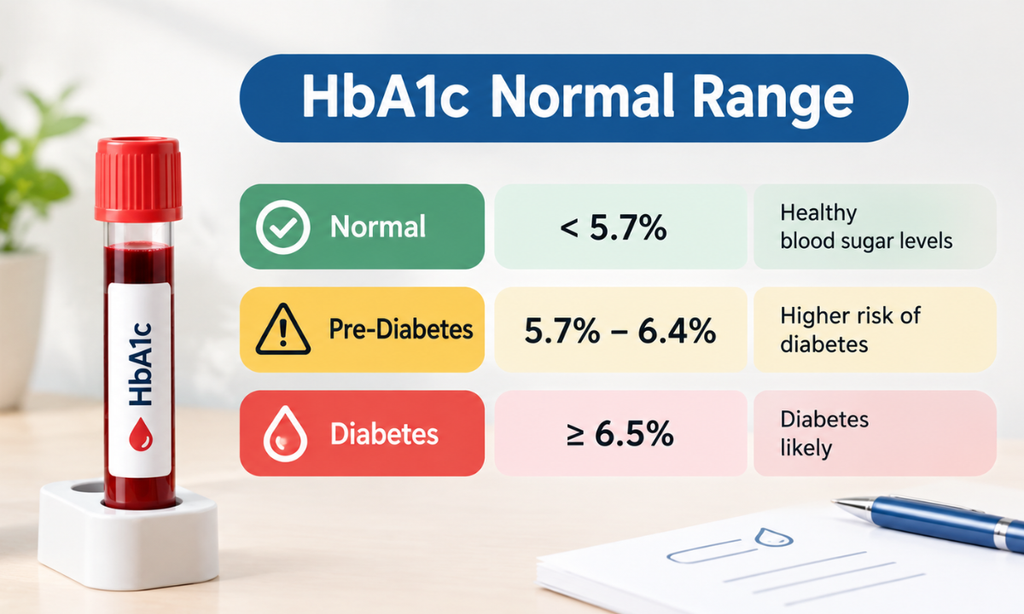
The commonly used HbA1c interpretation is:
| HbA1c Level | General Interpretation |
| Below 5.7% | Normal range |
| 5.7%–6.4% | Prediabetes range |
| 6.5% or above | Diabetes range |
These ranges are commonly used for screening and diagnosis, but an HbA1c result should be interpreted along with your medical history and, when required, repeat or additional testing.
A single abnormal result does not always provide the complete clinical picture.
HbA1c and Estimated Average Glucose
Some laboratory reports also provide Estimated Average Glucose (eAG).
eAG converts the HbA1c result into an estimated average blood glucose value, usually expressed in mg/dL.
This can make the result easier to understand because most people are more familiar with blood glucose readings than percentages.
The relationship is approximate rather than an exact conversion of every individual glucose reading.
Who Should Get an HbA1c Test?
An HbA1c test may be recommended for people who:
- Have diabetes
- Have prediabetes
- Have risk factors for type 2 diabetes
- Have a family history of diabetes
- Are overweight or have obesity
- Have high blood pressure
- Have previously had abnormal blood sugar results
- Have symptoms that may be associated with high blood sugar
- Need to monitor existing diabetes
- Are undergoing a preventive health assessment
The appropriate frequency of testing depends on your health status and your doctor’s advice.
HbA1c Test for Diabetes
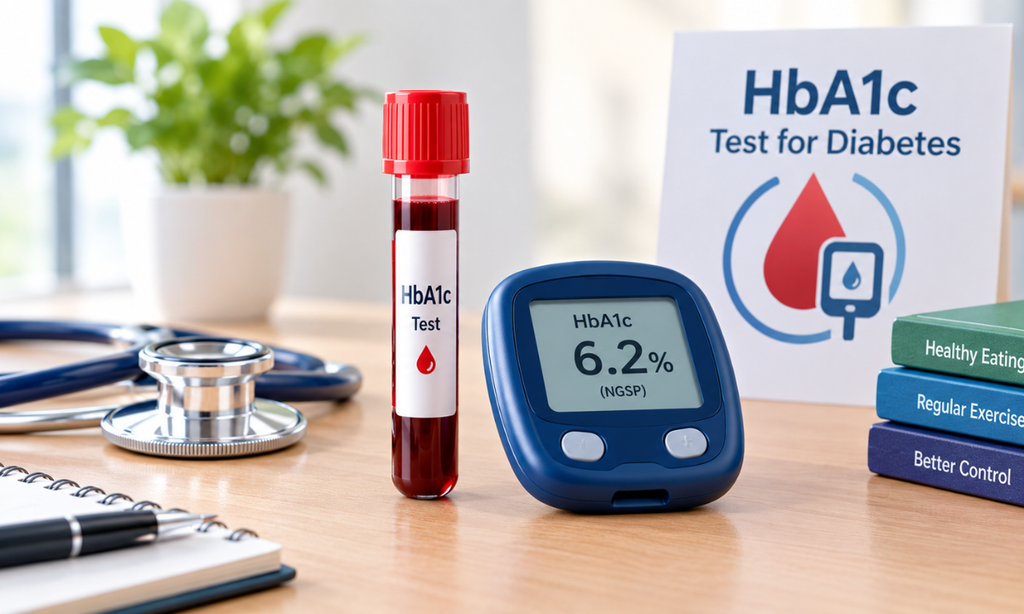
For people with diabetes, HbA1c is an important tool for monitoring long-term blood sugar control.
Unlike checking blood glucose at one specific time, HbA1c provides a broader picture of glucose levels over the preceding several weeks.
Doctors may use changes in HbA1c to assess whether a diabetes management plan is working as expected.
The frequency of testing varies. People with diabetes may be advised to repeat the test periodically, particularly when treatment changes or blood sugar control is not at the desired level.
HbA1c Test for Prediabetes
Prediabetes means blood glucose levels are higher than the normal range but have not reached the diagnostic threshold for diabetes.
An HbA1c result between 5.7% and 6.4% falls within the commonly used prediabetes range.
If your result falls in this range, your doctor may consider factors such as:
- Weight
- Blood pressure
- Family history
- Diet
- Physical activity
- Fasting glucose
- Other metabolic risk factors
Lifestyle changes and appropriate medical follow-up can help reduce the risk of progression to type 2 diabetes.
HbA1c Test Without Fasting
One of the main advantages of the HbA1c test is that fasting is generally not required.
You can usually eat and drink normally before the test.
This makes HbA1c convenient for people who cannot easily attend a laboratory appointment after an overnight fast.
However, if your doctor has prescribed HbA1c along with other blood tests such as fasting blood sugar or a lipid profile, you may still need to fast for those additional tests.
For example, Koshikaa’s Standard Health Check-up includes several tests alongside HbA1c, and the preparation requirements for the complete package can therefore be different from HbA1c alone.
Do You Need to Fast Before an HbA1c Test?
No, HbA1c alone does not normally require fasting.
You can generally:
- Eat before the test
- Drink water
- Take the test at different times of the day
If your doctor has ordered other tests at the same appointment, follow the preparation instructions for the complete test panel.
If you are taking regular medication, do not stop it simply because you are having an HbA1c test. Follow your doctor’s instructions and inform the laboratory about the medicines you take.
How Is the HbA1c Test Done?
The procedure is straightforward.
Step 1: Registration
Your details and test request are confirmed.
Step 2: Blood Sample Collection
A trained healthcare professional collects a small blood sample, usually from a vein in your arm.
Step 3: Laboratory Analysis
The sample is processed using laboratory equipment to determine the HbA1c percentage.
Step 4: Report
Your HbA1c result is provided as a percentage. Some reports may also show estimated average glucose.
The actual sample collection generally takes only a few minutes.
What Sample Is Required for HbA1c?
HbA1c requires a blood sample.
A small amount of blood is collected from a vein and sent for laboratory analysis.
No urine sample is required for the HbA1c test itself.
HbA1c Test Price in Bangalore
The HbA1c test price in Bangalore varies between diagnostic centres depending on factors such as laboratory, collection method, location, home collection and whether the test is part of a package.
At Koshikaa, the currently listed rates are:
| HbA1c Testing Option | Koshikaa Price |
| HbA1c – Lab Visit | ₹299 |
| HbA1c – Home Sample Collection | ₹349 |
Koshikaa also includes HbA1c in selected health checkup packages.
The Standard Health Check-up is ₹1,599, while the Advanced Health Check-up is ₹2,599. The Advanced package includes HbA1c along with other tests such as kidney function, thyroid function, iron profile and CRP.
HbA1c Test at Home in Bangalore
If visiting a diagnostic centre is inconvenient, home sample collection can be useful.
Koshikaa currently lists HbA1c home collection at ₹349.
The process generally involves:
- Booking the test
- Providing the required contact and address details
- A phlebotomist visiting the specified location
- Blood sample collection
- Laboratory processing
- Receiving the report
Since HbA1c does not normally require fasting, home collection can be scheduled according to convenience.
HbA1c Test Report
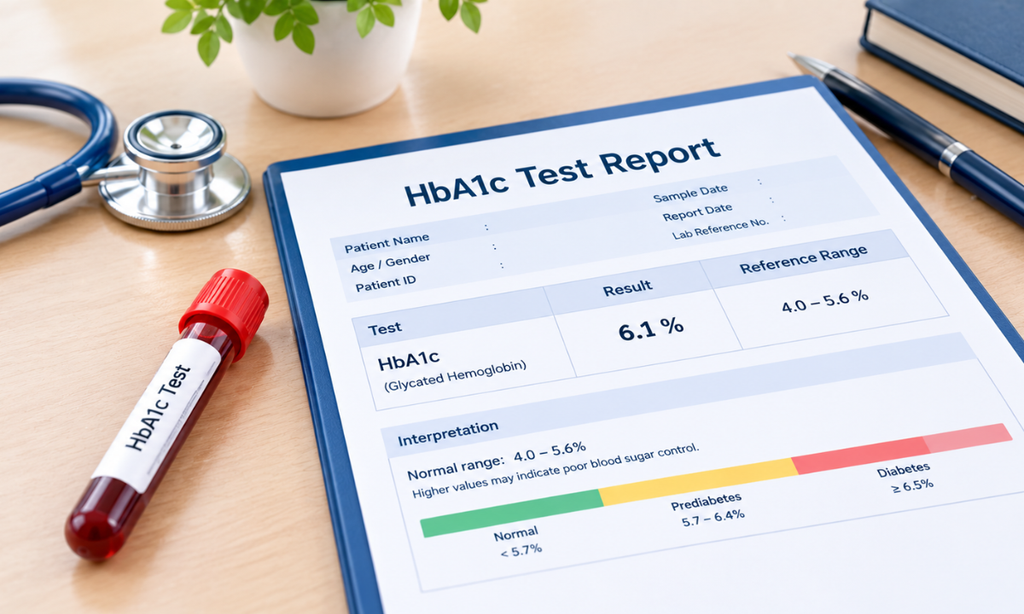
Your HbA1c report generally contains the HbA1c percentage.
Depending on the laboratory, it may also include:
- Reference range
- Estimated Average Glucose (eAG)
- Laboratory comments
- Interpretation guidance
A report should be considered together with other blood glucose measurements and your medical history.
HbA1c vs Fasting Blood Sugar
HbA1c and fasting blood sugar provide different information.
| HbA1c | Fasting Blood Sugar |
| Reflects average glucose over approximately 2–3 months | Measures glucose at one point in time |
| Usually does not require fasting | Requires fasting when specifically ordered as FBS |
| Reported as a percentage | Reported in mg/dL |
| Useful for long-term glucose monitoring | Useful for current fasting glucose assessment |
| Can be used for diabetes screening | Can be used for diabetes screening |
Doctors may use both tests because they provide complementary information.
HbA1c vs Random Blood Sugar
A random blood sugar test measures glucose at a particular point in time, regardless of when you last ate.
HbA1c provides a longer-term average.
Therefore, a person can have a normal random glucose result at one particular moment while still having an elevated HbA1c.
Conversely, temporary factors can affect individual blood glucose readings.
Your doctor may use both results to understand your overall blood sugar pattern.
Can HbA1c Detect Diabetes?
HbA1c can be used as one of the tests for diagnosing diabetes.
A result of 6.5% or above is within the diabetes range commonly used for diagnosis.
However, diagnosis should be made according to appropriate clinical criteria. Depending on the situation, your doctor may recommend repeat testing or another glucose test to confirm the result.
Can HbA1c Detect Prediabetes?
Yes.
An HbA1c result between 5.7% and 6.4% is generally classified as the prediabetes range.
If your result falls within this range, it is useful to discuss the result with a healthcare professional and assess other risk factors.
How Often Should HbA1c Be Tested?
There is no single testing schedule that applies to everyone.
People with diabetes may be advised to have HbA1c checked approximately every three to six months, depending on their level of glucose control and treatment changes.
People without diabetes may require testing less frequently, depending on their age and risk factors.
Your doctor can recommend the appropriate interval based on your individual situation.
What Can Affect an HbA1c Result?
HbA1c is useful, but it does not always tell the entire story.
Certain conditions affecting red blood cells or haemoglobin can influence the result.
Examples can include:
- Certain types of anaemia
- Blood loss
- Blood transfusion
- Some haemoglobin variants
- Conditions affecting red blood cell lifespan
- Certain kidney or liver conditions
If you have a condition that could affect HbA1c interpretation, tell your doctor or laboratory before testing.
Can HbA1c Be Normal While Blood Sugar Is High?
HbA1c represents an average rather than every individual blood sugar reading.
Therefore, occasional high or low glucose readings may not always be obvious from the HbA1c result alone.
If you are experiencing symptoms or have abnormal home glucose readings despite an HbA1c result that appears normal, discuss the difference with your doctor.
Can HbA1c Be Done During Illness?
HbA1c is generally less affected by short-term fluctuations than a single glucose measurement.
However, certain medical conditions can affect the accuracy or interpretation of the test.
If you are currently ill, taking new medication or have recently experienced significant blood loss or another major health event, inform your healthcare provider.
How to Prepare for an HbA1c Test
For an HbA1c test alone, preparation is usually simple.
- Fasting is generally not required.
- You can normally eat and drink before the test.
- Drink enough water to stay hydrated.
- Continue prescribed medicines unless your doctor advises otherwise.
- Inform the laboratory about medications and supplements you take.
- Carry previous reports if you are monitoring diabetes.
- If HbA1c is being done with other tests, follow the preparation requirements for those tests.
Koshikaa specifically states that HbA1c does not require fasting and can be tested at any time of the day.
HbA1c Test at Koshikaa
Koshikaa provides HbA1c testing as an individual blood test as well as part of selected health checkup packages.
Individual HbA1c Test
Lab visit: ₹299
HbA1c Home Collection
Home sample collection: ₹349
Standard Health Check-up
Price: ₹1,599
The Standard package includes HbA1c along with CBC, LFT, KFT, blood sugar, lipid profile, thyroid function, Vitamin B12, Vitamin D and urine analysis.
Advanced Health Check-up
Price: ₹2,599
The Advanced package includes HbA1c along with additional investigations such as kidney function, thyroid function, iron profile, CRP and other tests.
If you only need HbA1c, an individual test may be appropriate. If you want a broader assessment of diabetes risk and general health, a health checkup package may provide additional relevant tests.
View Koshikaa Full Body Checkup in Bangalore
Why Choose Koshikaa for HbA1c Testing in Bangalore?
Affordable HbA1c Testing
Koshikaa currently lists HbA1c at ₹299 for a lab visit and ₹349 for home sample collection.
Home Sample Collection
You can choose home sample collection when visiting the laboratory is inconvenient.
No Fasting for HbA1c
HbA1c alone does not require fasting, making it convenient for testing at different times of the day.
Individual Test or Health Package
You can choose between an individual HbA1c test and broader health checkup packages depending on your requirements.
Doctor-Reviewed Health Checkups
Koshikaa’s health checkup packages include doctor review of reports, helping patients understand their broader screening results.
Frequently Asked Questions About HbA1c Test in Bangalore
What is the HbA1c test?
HbA1c is a blood test that measures the percentage of haemoglobin with glucose attached to it. It provides an estimate of average blood sugar over approximately two to three months.
What is the HbA1c normal range?
An HbA1c below 5.7% is generally considered within the normal range. A result of 5.7%–6.4% is in the prediabetes range, while 6.5% or above is in the diabetes range.
Does HbA1c require fasting?
No. HbA1c generally does not require fasting.
Can I drink water before an HbA1c test?
Yes. Drinking water is generally permitted before an HbA1c test.
How much does an HbA1c test cost in Bangalore?
The cost varies by diagnostic centre and collection method. Koshikaa currently lists the HbA1c test at ₹299 for a lab visit and ₹349 for home sample collection.
What is the HbA1c test price at Koshikaa?
Koshikaa currently lists HbA1c at ₹299 for a laboratory visit and ₹349 for home sample collection.
Can HbA1c be done at home?
Yes. Koshikaa offers home sample collection for HbA1c.
How long does an HbA1c test take?
Blood sample collection itself generally takes only a few minutes. Report delivery time depends on the laboratory and testing process.
Can I take an HbA1c test at any time of the day?
Yes. Since fasting is generally not required, HbA1c can usually be tested at a convenient time.
What HbA1c level indicates prediabetes?
An HbA1c level from 5.7% to 6.4% is generally classified as the prediabetes range.
What HbA1c level indicates diabetes?
An HbA1c level of 6.5% or above falls within the diabetes range commonly used for diagnosis. Your doctor may recommend confirmation depending on your clinical situation.
How often should a person with diabetes check HbA1c?
Many people with diabetes are advised to check HbA1c every three to six months, but the appropriate frequency depends on individual blood sugar control and treatment changes.
Is HbA1c better than fasting blood sugar?
They measure different aspects of blood glucose. HbA1c reflects longer-term average glucose, while fasting blood sugar measures glucose at a particular fasting point. Both can be useful.
Can HbA1c diagnose diabetes?
Yes, HbA1c can be used as a diagnostic test for diabetes when interpreted according to accepted clinical criteria.
Book an HbA1c Test in Bangalore
If you are looking for an HbA1c test in Bangalore, Koshikaa provides both individual testing and home sample collection.
HbA1c – Lab Visit: ₹299
HbA1c – Home Collection: ₹349
For people who want a broader health assessment, Koshikaa also offers health checkup packages that include HbA1c.
Koshikaa Screening Centre
2nd Floor, 2227, 9th Main Road, Karesandra, Banashankari Stage II, Banashankari, Bengaluru, Karnataka 560070
Phone: +91 7996666106
Email: koshikaascreening@gmail.com
Final Takeaway
The HbA1c test provides a longer-term view of blood sugar than a single glucose measurement. It is commonly used for diabetes screening, prediabetes assessment and monitoring of people with diabetes.
The test generally does not require fasting, and the result is reported as a percentage of glycated haemoglobin.
For Bangalore residents, Koshikaa currently offers HbA1c testing at ₹299 for a lab visit and ₹349 with home sample collection, while HbA1c is also available as part of broader health checkup packages.
If your HbA1c result is outside the expected range, discuss the result with a qualified healthcare professional before making changes to medication or treatment.