
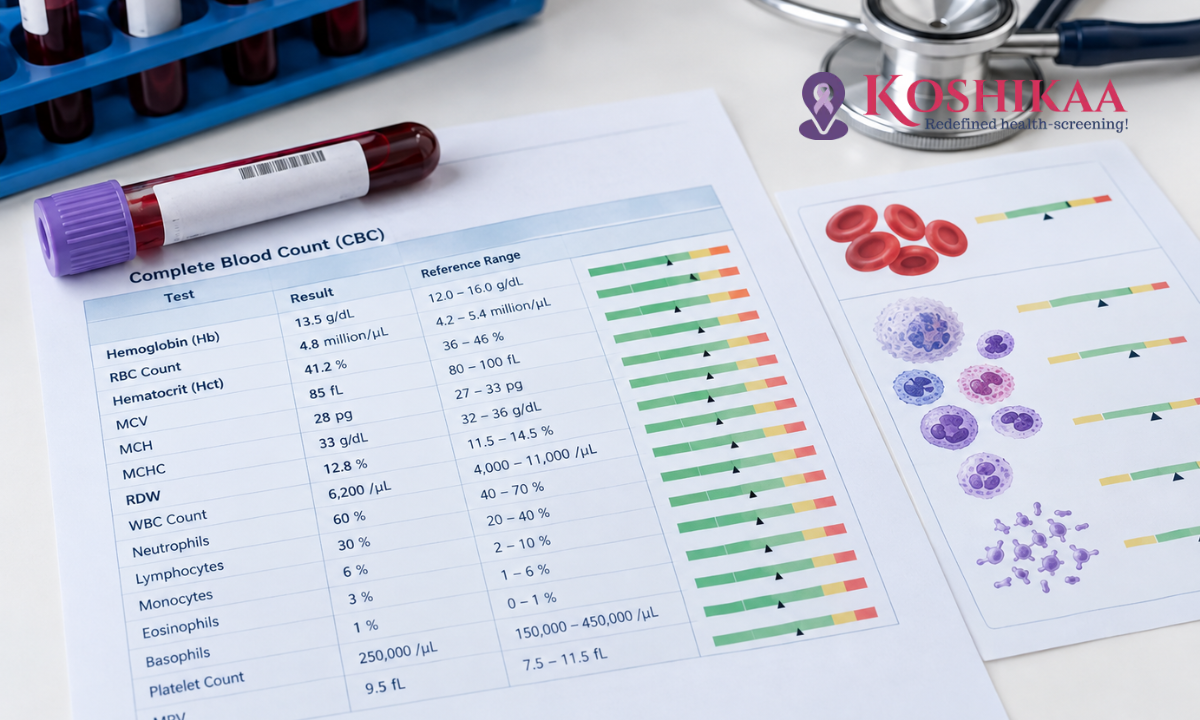
A CBC blood test, or complete blood count, is one of the most commonly ordered medical tests. From a single small blood sample, it measures the main types of cells in your blood: red blood cells, white blood cells and platelets, along with haemoglobin and several related values.
Doctors use the complete blood count test for many reasons. It can help investigate symptoms such as tiredness, fever or easy bruising, check general health during a routine check-up, monitor long-term conditions and treatments, and assess fitness before surgery.
Understanding a CBC report can feel confusing because it contains so many abbreviations and numbers. This guide explains what each part of the test measures, typical normal ranges, what high or low results may suggest and how to prepare. One principle runs throughout: a CBC screens and supports assessment, but it does not on its own diagnose cancer, identify the type of infection or confirm the cause of anaemia. A single value outside the range is a reason for further assessment, not a diagnosis. Results should always be interpreted by a doctor, such as the specialists at Koshikaa Group, alongside your symptoms and medical history.
What Is a CBC Blood Test?
What Does a Complete Blood Count Measure?
A CBC measures three main groups of blood cells:
•Red blood cells, which carry oxygen from the lungs to the rest of the body
•White blood cells, which help the body fight infection
•Platelets, which help the blood clot and stop bleeding
Alongside these counts, the test reports haemoglobin, haematocrit and red cell indices such as MCV, MCH, MCHC and RDW. Many laboratories also include a differential count, which breaks down the different types of white blood cells.
Why Might a Doctor Recommend a CBC?
A doctor may recommend a CBC to:
•Investigate symptoms such as fatigue, weakness, breathlessness, fever, unexplained weight loss or easy bruising
•Check for anaemia, infection, inflammation or bleeding problems
•Monitor long-term conditions, such as kidney disease or autoimmune conditions
•Monitor treatments that can affect blood counts, such as chemotherapy or certain long-term medicines
•Assess general health as part of a routine check-up
•Check blood counts before surgery or certain procedures
Because it is quick, widely available and inexpensive, the CBC is often one of the first tests a doctor orders.
CBC Test Components and Their Functions
Haemoglobin and Red Blood Cells
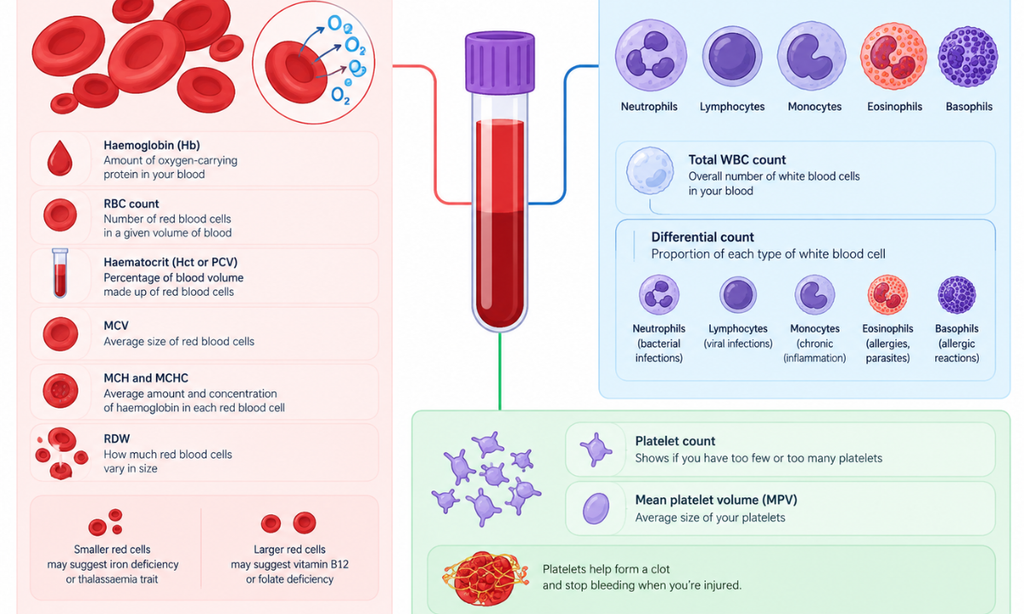
Red blood cells contain haemoglobin, an iron-rich protein that carries oxygen around the body. The red cell section of a CBC usually includes:
•Haemoglobin (Hb): the amount of oxygen-carrying protein in your blood. Low haemoglobin is the main sign of anaemia. For a detailed explanation, read our guide to the haemoglobin blood test.
•Red blood cell (RBC) count: the number of red blood cells in a given volume of blood
•Haematocrit (Hct or PCV): the percentage of your blood volume made up of red blood cells
•MCV (mean corpuscular volume): the average size of your red blood cells
•MCH and MCHC: the average amount and concentration of haemoglobin in each red blood cell
•RDW (red cell distribution width): how much your red blood cells vary in size
These red cell indices help doctors work out the likely cause of anaemia. For example, small red cells may suggest iron deficiency or thalassaemia trait, while large red cells may suggest vitamin B12 or folate deficiency.
White Blood Cells and Differential Count
White blood cells (leukocytes) are part of the immune system. The CBC reports the total white blood cell count, and the differential count shows the proportion of each type: neutrophils, lymphocytes, monocytes, eosinophils and basophils. Each type plays a different role, so changes in the pattern can help doctors judge whether a problem is more likely to be a bacterial or viral infection, an allergy or another condition.
Platelets and Blood Clotting
Platelets are small cell fragments that gather at the site of an injury and help form a clot. The platelet count shows whether you have too few, which can increase the risk of bleeding, or too many, which may occur with inflammation or some other conditions. Some reports also include mean platelet volume (MPV), the average size of your platelets.
CBC Blood Test Normal Range
The ranges below are typical adult reference values. Always use the reference range printed on your own report, as ranges vary between laboratories, analysers, age groups and during pregnancy. Children have different ranges.
Adult Haemoglobin and Red Blood Cell Ranges
| Parameter | Typical Adult Reference Range |
| Haemoglobin (men) | 13.0 to 17.0 g/dL |
| Haemoglobin (women) | 12.0 to 16.0 g/dL |
| RBC count (men) | 4.7 to 6.1 million cells/µL |
| RBC count (women) | 4.2 to 5.4 million cells/µL |
| Haematocrit (men) | About 41 to 50 per cent |
| Haematocrit (women) | About 36 to 44 per cent |
| MCV | 80 to 95 fL |
| MCH | 27 to 31 pg |
| MCHC | 32 to 36 g/dL |
| RDW-CV | About 11.5 to 14.5 per cent |
White Blood Cell and Platelet Ranges
Reference ranges vary between laboratories, analysers, age groups and populations. Always compare your result with the reference range printed on your own report.
| Parameter | Typical Adult Reference Range |
| Total white blood cell count | 4,500 to 11,000 cells/µL |
| Platelet count | 1.5 to 4.0 lakh/µL (150,000 to 400,000/µL) |
Normal ranges for the differential count, along with ESR, are covered in our guide to the Hb, TC, DC, ESR and platelet test.
What Do High or Low CBC Results Mean?
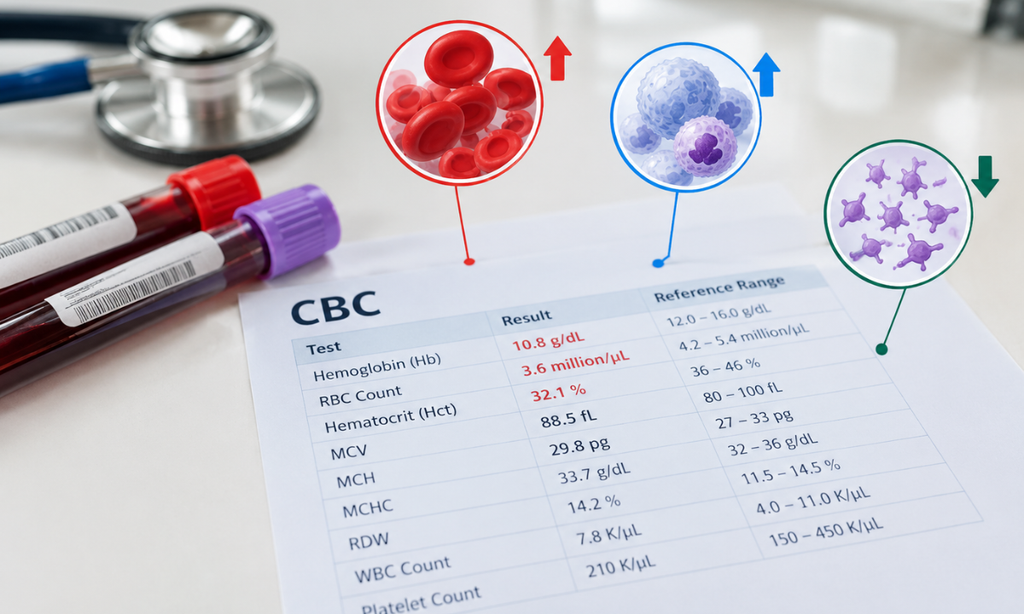
Reference ranges are designed to include most, but not all, healthy people, so a small proportion of healthy people may fall just outside them. A single mildly abnormal value is not necessarily a cause for concern. Your doctor will look at the overall pattern.
Red Blood Cell and Haemoglobin Results
•Low haemoglobin, RBC count or haematocrit indicates anaemia. Common causes include iron deficiency, vitamin B12 or folate deficiency, blood loss, chronic illness and inherited conditions such as thalassaemia. Iron deficiency anaemia is particularly common in India, especially among women.
•High haemoglobin or haematocrit may occur with dehydration, smoking, living at high altitude or, less commonly, lung, heart or bone marrow conditions.
•Abnormal MCV, MCH or RDW values help narrow down the type and cause of anaemia, but they are interpreted together rather than individually.
White Blood Cell Results
•A high white blood cell count is most often linked to infection or inflammation. It can also follow stress, intense exercise, smoking or medicines such as steroids. Rarely, a very high count may indicate a blood disorder.
•A low white blood cell count may occur with some viral infections, certain medicines, autoimmune conditions or problems affecting the bone marrow.
Platelet Results
•A low platelet count can occur with viral infections such as dengue, certain medicines, immune conditions, liver disease or bone marrow problems. Dengue cannot be diagnosed from a platelet count alone, so specific tests are needed.
•A high platelet count may be seen after infection, inflammation, surgery, iron deficiency or, less commonly, a bone marrow disorder.
When Several Values Are Abnormal Together
If more than one cell type is affected, for example low red cells, white cells and platelets together, your doctor may recommend further tests promptly, as this pattern can point to a problem with blood cell production.
How to Read Your CBC Report
A CBC report usually lists each parameter with your result, the unit of measurement and the laboratory’s reference range. Values outside the range are often marked as high (H) or low (L). A simple approach can help you make sense of it before you speak to your doctor:
•Start with the three main cell lines: look at haemoglobin for red cells, the total white blood cell count and the platelet count.
•Check the units: some laboratories report counts per microlitre, others per cubic millimetre or in lakhs, so compare like with like.
•Look at the red cell indices together: MCV, MCH and RDW help explain why haemoglobin may be low.
•Compare with previous reports: a change over time can be more informative than a single result.
•Note any symptoms: fever, bleeding, tiredness or weight loss help your doctor interpret the numbers.
Do not change medicines or start supplements based on your report alone. Our guide to understanding your reports and next steps explains what to do after a health check-up.
How to Prepare for a CBC Test
Do You Need to Fast Before a CBC?
Fasting is generally not needed for a CBC on its own. However, if other tests such as blood sugar or a lipid profile are being collected at the same time, you may need to fast. Follow the instructions you are given when you book.
What Should You Tell the Team?
Let the team know about any medicines or supplements you take, including iron or vitamins, and any recent illness, blood transfusion or heavy bleeding. Pregnancy also affects several CBC values, so mention this if relevant.
What Happens During the Test?
A trained phlebotomist takes a small blood sample from a vein in your arm. It takes only a few minutes, and you can usually return to your normal activities straight away.
How Much Does a CBC Blood Test Cost at Koshikaa?
At Koshikaa, a CBC is currently listed at ₹299 at the centre and ₹349 with home sample collection. Report timing depends on the test panel and laboratory workflow, and the centre will confirm the expected reporting time when you book.You can book through our blood test services in Bengaluru.
Frequently Asked Questions
What is the difference between a CBC and a haemogram?
The terms are often used interchangeably in India. A haemogram often refers to a CBC, sometimes with ESR or additional parameters added. Exact panels vary by laboratory, so check what is included when you book.
Is ESR part of a CBC blood test?
No. ESR (erythrocyte sedimentation rate) is not a standard CBC component and is usually ordered separately, although it is often requested alongside a CBC.
Can a CBC detect cancer?
A CBC cannot diagnose cancer. It may show changes, such as abnormal blood counts or anaemia, that prompt further investigation, but many cancers produce a normal CBC. A cancer diagnosis usually requires clinical assessment and additional tests.
Can a CBC detect infection?
It can suggest infection, for example through a raised white blood cell count or changes in the differential count. However, it cannot identify the exact infection, so your doctor may recommend further tests.
How often should I have a CBC test?
There is no single schedule for everyone. Healthy adults often have a CBC as part of a routine check-up, while people with certain conditions or on certain treatments may need regular monitoring as advised by their doctor.
Should I worry if one CBC value is slightly out of range?
Usually not. Small variations are common in healthy people. Your doctor will consider the full report, your symptoms and any previous results, and may suggest repeating the test.
Conclusion
The CBC blood test gives a valuable overview of your blood health, measuring red cells, white cells, haemoglobin and platelets from a single sample. It helps doctors investigate symptoms, monitor long-term conditions and check general health. The numbers are most meaningful when read together and in context, so always review your report with a qualified doctor.
To book a CBC or a broader health check-up, visit Koshikaa at 2nd Floor, 2227, 9th Main Road, Karesandra, Banashankari Stage II, Bengaluru, or call +91 7996666106.
References