
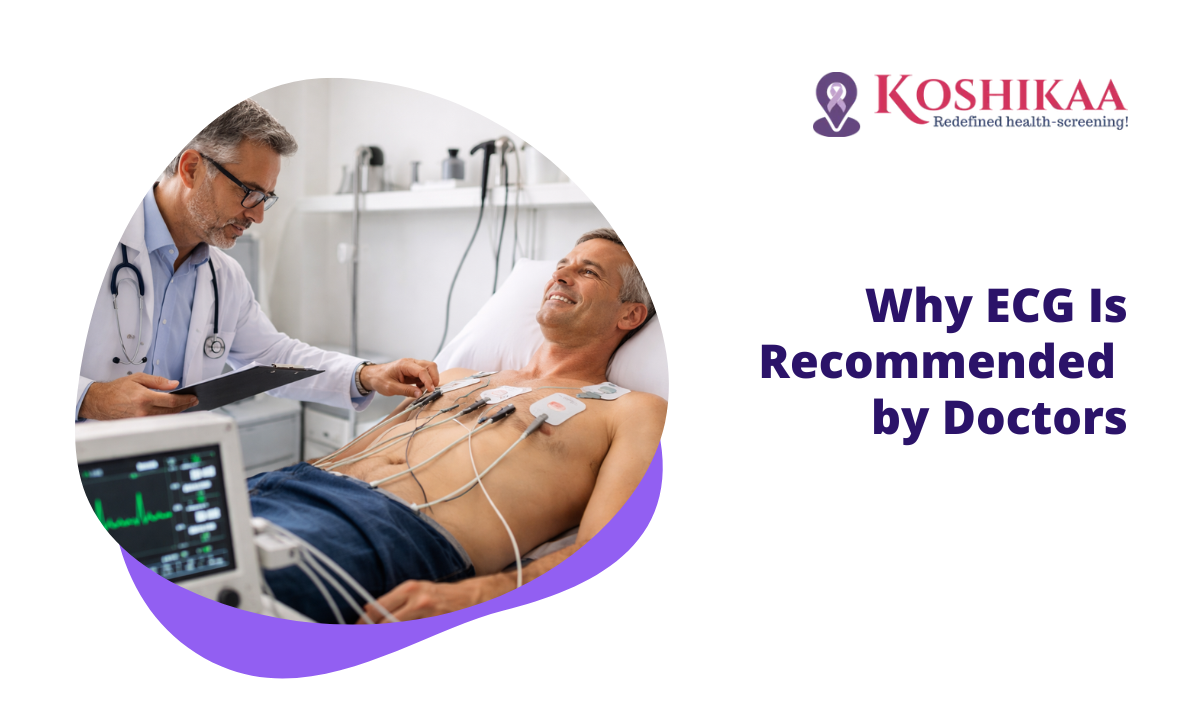
You walk into a clinic for a routine check-up or perhaps for a nagging cough, and suddenly your doctor hands you a prescription for an ECG test. Panic sets in. “Is something wrong with my heart?” “Am I having a silent heart attack?”
Relax. While it is natural to feel anxious, an Electrocardiogram test (ECG) is rarely a sign of immediate doom.
In fact, it is one of the most common and safest diagnostic tools in modern medicine. Think of it as a “dashboard check” for your body’s engine.
Just because the “Check Engine” light flickers doesn’t mean the car is broken; it just means we need to look under the hood.
Understanding why doctors recommend ECG can turn that anxiety into action.
Whether it is to investigate a specific symptom or just to establish a baseline for your health, this simple 10-minute test provides a wealth of information about your heart’s electrical health.
We believe that knowing why you are being tested is just as important as the test itself. Let’s decode the reasons behind this common prescription.
Reason 1: Symptoms You Can Feel
Ruling out the dangerous stuff first.
The most obvious reason a doctor orders an ECG test is that you mentioned a specific symptom that could be heart-related.
The heart is a master of disguise. Its warning signs often mimic other, less serious conditions like indigestion or anxiety.
1. Chest Pain (Angina vs. Acid Reflux) In India, “Gas” is the most common self-diagnosis. But clinically, burning or tightness in the chest can also be Angina (reduced blood flow to the heart).
- The ECG Role: It helps the doctor quickly differentiate. If the ECG shows “ST-segment changes,” it is likely the heart. If the ECG is normal, it might indeed be just acidity.
2. Palpitations (Fluttering) Have you ever felt like your heart “skipped a beat” or is racing like a galloping horse while you are just sitting on the couch? This is called Palpitations.
- The ECG Role: It captures the electrical rhythm to see if you have an Arrhythmia (irregular heartbeat) like Atrial Fibrillation.
3. Unexplained Dizziness or Fainting If you feel lightheaded when standing up or have actually fainted (Syncope), it might mean your heart rate is dropping too low (Bradycardia) to pump blood to your brain.
It checks if your natural pacemaker (SA Node) is firing correctly.
Reason 2: Preventive Checks
Why do you need an ECG even if you feel fine?
Sometimes, the danger isn’t what you feel; it’s what you don’t feel.
Doctors often recommend an ECG as part of an annual check-up at a Health screening centre in Bangalore, especially for patients over 30.
This is because certain “lifestyle diseases” quietly damage the heart structure over the years before a single symptom appears.
The Silent Saboteurs:
| The Condition | How it Affects the Heart | What the ECG Sees |
|---|---|---|
| High Blood Pressure (Hypertension) | Your heart has to push harder against high pressure. Over time, the heart muscle thickens (gets bulky) to cope. | Left Ventricular Hypertrophy (LVH): The electrical waves look taller because the muscle is bigger. |
| Diabetes | High sugar damages blood vessels and nerves. Diabetics often suffer “Silent Ischemia” (heart attacks with no pain). | ST-T Changes: Subtle shifts in the wave pattern indicate poor blood flow, even without chest pain. |
| Family History | Genetics play a huge role. If your parents had heart issues young age, you are at a higher risk. | Baseline Anomalies: Doctors look for inherited rhythm disorders like Long QT Syndrome. |
Even if your ECG is normal today, that is valuable! It gives your doctor a “Normal Value” baseline.
If you have chest pain 5 years later, they can compare the new ECG to the old one. If the lines have changed, they know the problem is new and acute.
Reason 3: The Pre-Game Check (Surgery & Fitness)
Clearance for the big events.
An ECG isn’t always about finding disease; sometimes, it’s about ensuring safety before a major physical stress.
1. Pre-Operative Clearance Before almost any surgery (even something unrelated to the heart, like a knee replacement or gallbladder removal), an anesthetist will demand an ECG.
- Why: General anesthesia slows down your body functions. The doctors need to know your heart is strong enough to handle the anesthesia and wake up safely.
In fitness-conscious cities like Bangalore, many gyms and marathon organizers now advise an ECG before starting intense training.
Intense cardio puts sudden stress on the heart. If you have a hidden condition (like Hypertrophic Cardiomyopathy), heavy lifting or sprinting could trigger a dangerous rhythm. An ECG clears you for safe training.
What is a “Normal” Result?
Patients often anxiously search for ECG test normal value.
- The Reality: There is no single number. A normal ECG shows a “Sinus Rhythm” (regular beat) between 60–100 beats per minute, with all waves (P, QRS, T) in the right order and size. Anything deviating from this pattern requires a closer look.
Where to Get Tested?
High-quality diagnostics without the stress.
If your doctor recommends an ECG, your first thought might be, “I don’t have time to go to the hospital.” This is a valid concern in a city like Bangalore.
Taking half a day off work for a 10-minute test feels inefficient. Fortunately, technology has evolved. You no longer need a massive hospital machine to get an accurate reading.
Option 1: Clinical Labs & Hospitals
- Pros: Immediate doctor consultation if something is wrong.
- Cons: High waiting times, risk of hospital-acquired infections, and the stress of travel.
Option 2: ECG Test at Home in Bangalore
The technician comes to you. You lie in your own bed (which often gives a more accurate “resting” heart rate because you are relaxed).
Services like Koshikaa use FDA-approved portable ECG devices that are clinically equivalent to hospital systems.
- Cost: Surprisingly, the cost difference is minimal. The cost of an ECG test in India is generally low (ranging from ₹300 to ₹800 in labs), and home services usually charge a small convenience fee on top, making it highly affordable.
Koshikaa Promise: Our ECG services in Bangalore are designed for your comfort. Whether it’s for your elderly parents who can’t travel or for your own peace of mind, we bring the Health screening centre in Bangalore experience to your living room.
Conclusion
When a doctor recommends an ECG, they aren’t trying to scare you. They are trying to shield you. They are using one of the most reliable tools in medical history to ensure your heart is beating exactly as it should.
- If you have symptoms, it gives you answers.
- If you are healthy, it gives you a baseline.
- If you are preparing for surgery or the gym, it gives you safety.
So, the next time you see “ECG” on your prescription pad, don’t panic.
See it as a proactive step towards a longer, healthier life. And remember, with modern home healthcare, checking your heart is now as easy as ordering groceries.
Don’t skip the check. Book your ECG today.