
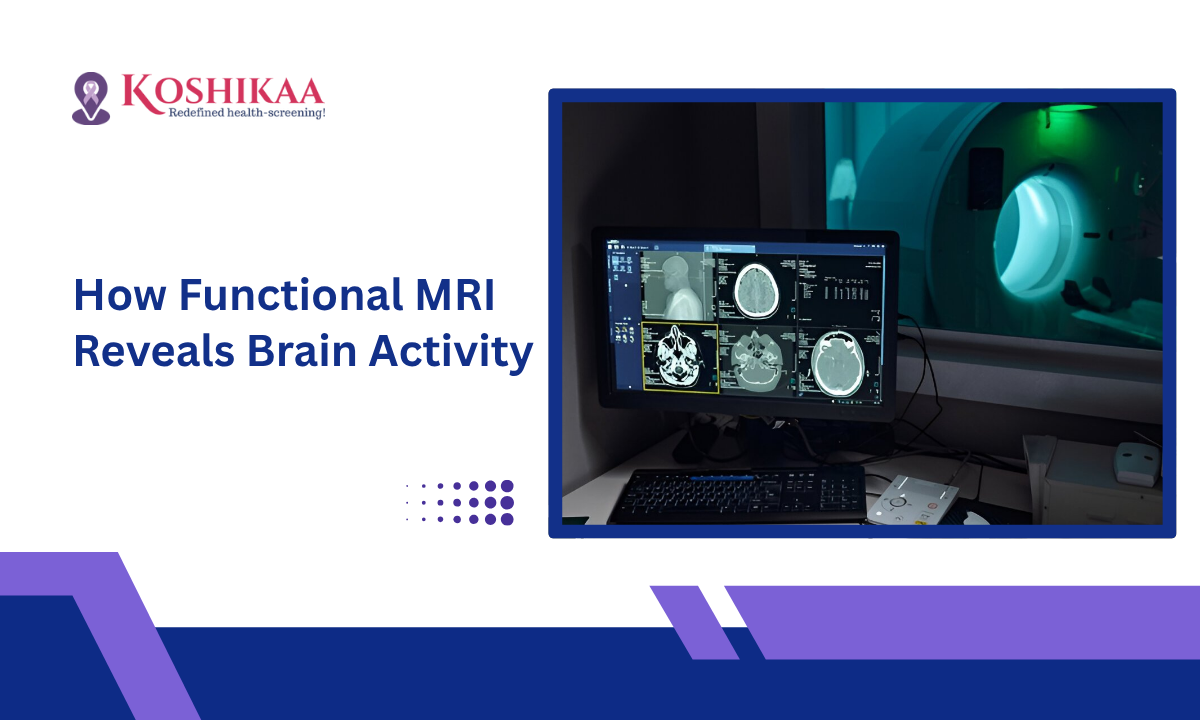
When we speak of Functional MRI, we refer to a powerful imaging tool that allows us to look not only at the structure of the brain, but at the working of the brain in real time. As a physician working at Koshikaa, I often explain to patients that a functional MRI scan is like switching on the lights in the brain to see which regions are really busy.
Functional MRI Meaning

The term “functional MRI” (often shown as fMRI) expands on traditional MRI by measuring the brain’s activity rather than simply capturing its anatomy. Specialized MRI techniques detect changes in blood flow: when an area of the brain is more active, it uses more oxygen, and blood flow to that region increases. That increase becomes visible on the scan. In essence, functional MRI is an advanced magnetic resonance scan tailored to map brain function by showing areas of activation.
Functional MRI of the Brain: How It Works
A functional MRI of the brain involves the patient lying within a high-field MRI machine. The process is similar to a regular MRI scan in terms of positioning and magnet use. However, during a functional MRI, the patient may be asked to perform simple tasks – such as moving a hand, reading a word, thinking of something, or responding to an audio cue. These tasks trigger brain regions to “light up” in terms of blood flow.
While lying in the scanner, the change in blood oxygenation and flow (known as the BOLD – Blood Oxygen Level Dependent – signal) is captured. These maps show which brain regions are active during the task or at rest. Because we can correlate a task with which region of the brain lights up, we gain valuable insight into brain activity that we could not get through anatomical MRI alone.
Functional MRI Uses
There are several clinical and research uses for functional MRI:
- Planning brain surgery: If we know which region controls language or motor function, we can avoid damaging it during surgery.
- Evaluating brain injuries and diseases: For example, after a stroke or in epilepsy, a functional MRI can help show which areas remain active or are impaired.
- Research into cognition, emotion, and brain networks: Functional MRI lets researchers study how different parts of the brain interconnect and change during tasks, rest, or injury.
- Assessment of brain recovery and rehabilitation: Seeing how brain function changes over time after an injury.
- Emerging uses: For example, concussion evaluation, brain-health screening, and monitoring change over time.
When talking about functional MRI uses, it covers both structural insights (which part of the brain is where) + functional insights (which part is doing what).
Functional MRI and Concussion
When a person has suffered a concussion, we worry about microscopic changes in brain function that don’t always show up on routine structural MRI scans. Here, a functional MRI can play a meaningful role. It may show altered patterns of blood flow or connectivity in brain networks involved in concentration, memory, or movement after a concussion.
At Koshikaa, we often explain that a functional MRI of the brain after a concussion gives a window into the brain’s recovery process. It helps us tailor rehabilitation, monitor progress, and in some cases decide when it’s safe to return to full activity or sports.
Functional Health MRI: A Broader View
While much of the emphasis is on brain imaging, the term functional health MRI can also refer more broadly to MRI techniques that assess function across organs or body systems (though less common than brain fMRI). The idea remains: going beyond anatomy into the realm of function, timing, and physiologic activity.
In practice at Koshikaa, when we talk about functional health MRI, we primarily mean the advanced imaging of brain activity, but we also keep the door open to future applications such as functional cardiac MRI, functional musculoskeletal MRI, and other organ-specific functional scans.
MRI Scan in Bangalore – Why the Location Matters
Choosing an MRI scan in Bangalore means access to advanced imaging equipment, experienced radiologists, and integrated care centres. At Koshikaa, located in Bangalore, we ensure that our MRI facility is equipped for both structural MRI and functional MRI, with dedicated protocols for brain health screening.
When you come to our centre for an MRI scan in Bangalore, you benefit from:
- Advanced MRI machines capable of functional studies
- Radiologists and neurologists who interpret functional MRI and conventional MRI in a complementary manner.
- A convenient location within Bangalore’s tech and healthcare hub, making it easier for referrals, second opinions, and follow-up.
The Advantage of Early Detection
At our health screening centre in Bangalore, we not only offer routine imaging; we offer comprehensive brain health evaluations. Incorporating functional MRI can elevate a screening programme from “what’s your brain anatomy” to “how is your brain functioning right now.” Early detection of subtle functional changes means earlier interventions and better outcomes.
We encourage individuals, especially those with risk factors (head injury history, concussion, cognitive complaints, high-stress lifestyle), to consider advanced functional MRI in their screenings alongside standard MRI.
Conclusion
Functional MRI has truly transformed the way we understand and visualize brain activity. By revealing which regions of the brain are engaged during specific tasks or at rest, this advanced imaging technique bridges the gap between anatomy and function. It empowers clinicians and researchers to gain a deeper insight into how the brain heals, adapts, and performs—helping guide treatment plans and rehabilitation strategies. At Koshikaa, we believe that knowledge is health, and tools like functional MRI allow us to see not just the structure of the brain, but its living, dynamic processes in action.
As the Best Health Screening Centre in Bangalore, we combine the latest MRI scan technology with expert medical interpretation to provide patients with precise, meaningful insights into their brain and overall health. Whether it’s for concussion assessment, surgical planning, or preventive screening, our focus remains on early detection and comprehensive understanding. Through advanced techniques like functional MRI, Koshikaa continues to redefine brain health imaging—offering every patient the clarity and confidence that come from seeing their brain function in real time.
FAQs
What is a functional MRI used for?
A functional MRI is used to assess brain activity by measuring changes in blood flow while a patient performs tasks or rests. It helps in surgical planning, diagnosis of functional impairment, research into brain networks, and monitoring of recovery.
How much does a functional MRI cost?
Costs can vary depending on the centre, machine strength, the region of the body being scanned, and whether contrast or special tasks are involved. In Bangalore, prices at advanced centres like ours may be higher than a standard MRI, given the specialised functional protocols and radiologist time. I recommend contacting our centre at Koshikaa for the current cost estimate.
What are the three types of MRI?
When people refer to types of MRI, they often mean:
- Structural MRI (conventional anatomy)
- Functional MRI (assessing activity, such as the one I’ve described)
- Specialized MRI (like diffusion MRI, perfusion MRI, or resting-state MRI)
Each serves a different purpose, though they use similar hardware.
What is a drawback of having an fMRI scan?
Some drawbacks include:
- The patient must lie very still for the duration of the scan, which can be uncomfortable for some.
- Functional MRI has lower temporal resolution than some other methods (neuronal events happen much faster than blood flow changes).
- Interpretation can be complex and subtle; functional changes may not always be definitive in individual cases.
Some patients may feel claustrophobic inside the scanner, or may have contraindications (implanted metal devices).