
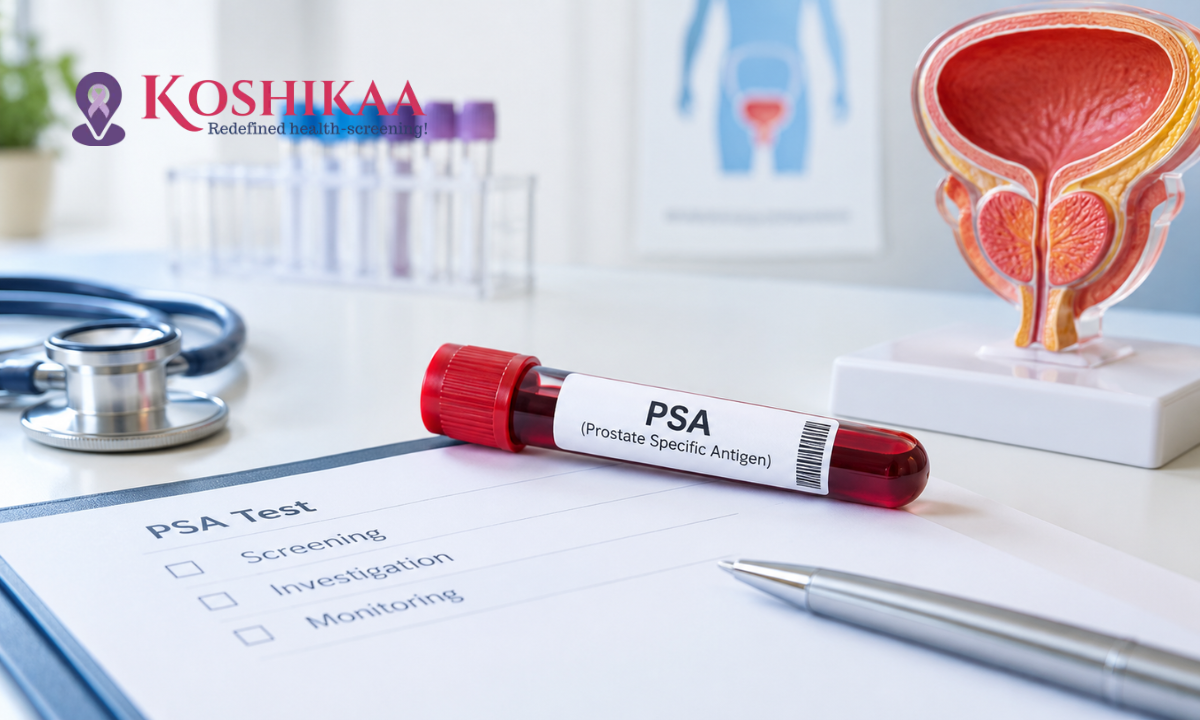
A PSA test is a simple blood test that measures prostate-specific antigen, a protein made by the prostate gland. Doctors may recommend it when discussing prostate cancer screening, investigating urinary symptoms or monitoring a prostate condition that has already been diagnosed. It is often included in a Health Checkup for Men in Bangalore as men get older.
The PSA blood test is useful, but it is often misunderstood. A raised PSA level does not automatically mean prostate cancer, and a normal result does not completely rule it out. Understanding what the number can and cannot tell you helps you have a more informed conversation with your doctor.
This guide explains why the test is done, how PSA levels are interpreted, what can raise them, how to prepare and what usually happens after an abnormal result.
What Is a PSA Test and Why Is It Done?
What Is Prostate-Specific Antigen?
Prostate-specific antigen is a protein produced by both normal and cancerous cells in the prostate, a small gland below the bladder in men. Its main role is to help liquefy semen. Most PSA stays in the semen, but small amounts enter the bloodstream, and this is what the test measures.
How Does the PSA Blood Test Work?
A small sample of blood is taken from a vein in the arm and sent to the laboratory, where the level of PSA is measured. The test itself takes only a few minutes, and most people can return to their normal activities straight away.
PSA Testing for Screening, Investigation and Monitoring
Doctors may use the PSA test in several ways: as part of prostate cancer screening in men without symptoms, to investigate urinary symptoms or an abnormal prostate examination, and to monitor men who have been treated for prostate cancer. In men who have had treatment, a rising PSA can be an early sign that the cancer has returned, often before any symptoms appear. PSA is one of several markers used in cancer assessment, and it is often discussed alongside other cancer detection tests in Bangalore.
What Is the Normal PSA Level by Age?
Understanding PSA Measurements in ng/mL
PSA is reported in nanograms per millilitre (ng/mL). In general, lower levels are more reassuring and higher levels are more likely to need further assessment.
Why PSA Reference Ranges Can Vary
There is no single PSA level that cleanly separates normal from abnormal. A level of 4 ng/mL has often been used as a reference point, but some men with lower levels have prostate cancer, and many men with higher levels do not. Laboratories may also use slightly different methods and reference ranges, which is why it helps to have repeat tests done at the same laboratory where possible.
Why Age, Symptoms and Previous Results Matter
PSA tends to rise naturally with age as the prostate grows. Some doctors use age-specific ranges as a general guide, such as those below.
| Age Group | Commonly Cited Upper Reference Level |
| 40 to 49 years | 2.5 ng/mL |
| 50 to 59 years | 3.5 ng/mL |
| 60 to 69 years | 4.5 ng/mL |
| 70 to 79 years | 6.5 ng/mL |
These are commonly cited age-based reference levels, not universal diagnostic cutoffs. Always interpret your result using your laboratory’s reference range and your doctor’s assessment.
Your doctor will interpret your result alongside your age, symptoms, family history, prostate size and any previous PSA results. If your result is above the laboratory’s reference range, your doctor may recommend repeat testing or further assessment rather than immediate biopsy.
What Does a High PSA Level Mean?
A raised PSA result means the prostate needs further assessment. It does not by itself mean cancer.
Benign Prostate Enlargement

Benign prostatic hyperplasia (BPH), a non-cancerous enlargement of the prostate that is common with age, is one of the most frequent causes of a raised PSA. A larger prostate simply produces more PSA, which is why doctors sometimes compare the PSA level with the size of the prostate.
Prostate Inflammation or Infection

Prostatitis and urinary tract infections can raise PSA, sometimes significantly. Levels often return towards normal once the inflammation or infection settles, which is why doctors may treat the infection first and repeat the test afterwards.
Temporary PSA Changes and Recent Activities
Ejaculation, vigorous cycling and recent procedures such as catheterisation, cystoscopy or prostate biopsy can temporarily increase PSA levels.
When an Elevated PSA May Need Further Investigation
If PSA is raised without an obvious temporary cause, remains high on repeat testing or is rising over time, your doctor may recommend further investigation to look for prostate cancer or other prostate conditions.
How to Prepare for a PSA Blood Test
Is Fasting Required Before a PSA Test?
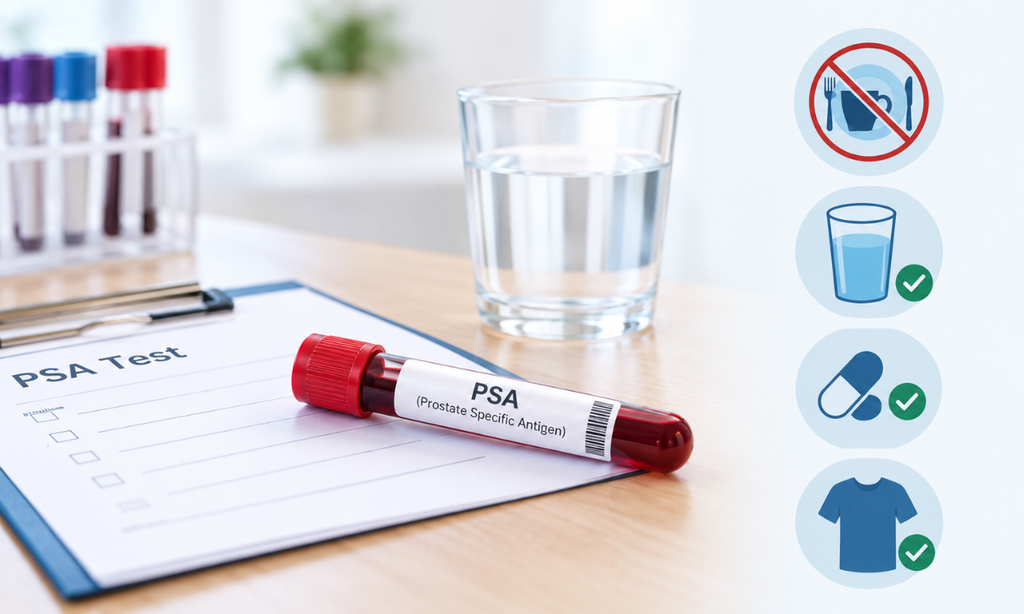
Fasting is not usually required for a PSA test alone. However, if your PSA test is part of a wider package that includes tests such as blood sugar or cholesterol, you may need to fast. Always follow the instructions given when you book.
What Activities or Recent Procedures Should You Mention?
You may be advised to avoid ejaculation and vigorous cycling for a short period, often around 48 hours, before the test. Tell the team if you have recently had a urinary catheter, cystoscopy, prostate biopsy or a prostate examination.
Which Medications and Urinary Symptoms Should You Disclose?
Some medicines used for prostate enlargement or hair loss, such as finasteride and dutasteride, can lower PSA levels and affect how results are interpreted. Do not stop these medicines before a test unless your doctor advises it; simply make sure the doctor reviewing your result knows you take them. Also mention any burning, frequent urination, fever or recent urinary infection, as testing may need to be delayed until an infection has cleared.
How to Understand Your PSA Test Results
What a Lower PSA Result May Indicate
A PSA level within the expected range for your age is generally reassuring, but it does not completely rule out prostate cancer. Your doctor may still recommend further checks if you have symptoms or other risk factors.
Why a Raised Result Does Not Confirm Cancer
Many men with a raised PSA do not have prostate cancer. The result is a signal for further assessment, not a diagnosis.
Why Changes Over Time Can Matter
A single result gives limited information. How PSA changes over months or years, sometimes called PSA velocity, can be more informative. Keep copies of all your PSA reports so they can be compared.
When to Consult a Urologist
If your PSA is raised, rising or accompanied by urinary symptoms, your doctor may refer you to a urologist for specialist assessment. Symptoms worth mentioning include a weak urine stream, needing to pass urine often at night, difficulty starting or stopping, blood in the urine or semen, and pain in the lower back or pelvis.
What Happens After an Abnormal PSA Result?
Repeat PSA Testing When Clinically Appropriate
Because PSA can rise temporarily, doctors often repeat the test after a few weeks, especially if an infection or recent activity may have affected the result.
Clinical Examination and Assessment of Risk Factors
Your doctor may carry out a digital rectal examination and review your age, family history and general health to judge your overall risk.
Additional Tests, Such as Free PSA or Prostate MRI, When Indicated
Tests such as free PSA, PSA density or a prostate MRI can help decide whether a biopsy is needed. Free PSA measures the portion of PSA that is not bound to proteins in the blood, and a lower proportion of free PSA may point to a higher risk. A prostate MRI can show areas that look suspicious and guide where a biopsy should be taken. Koshikaa offers MRI scans in Bangalore where clinically indicated.
When a Prostate Biopsy May Be Recommended
If the overall assessment suggests a meaningful risk of prostate cancer, a biopsy may be recommended to examine prostate tissue. Not everyone with a raised PSA needs a biopsy, and many men are safely monitored with repeat PSA tests and imaging instead.
Who Should Discuss PSA Screening With a Doctor?
How Age and General Health Influence Screening Decisions
Many guidelines suggest that men discuss PSA screening with their doctor from around the age of 50. The decision depends on general health and life expectancy, as well as personal preference.
Family History and Other Prostate Cancer Risk Factors
Men with a father or brother diagnosed with prostate cancer, particularly at a younger age, or with certain inherited genetic changes, may be advised to start these discussions earlier. Our age-wise health screenings can help you understand which tests may be relevant at different stages of life.
Benefits and Potential Harms of PSA Screening
PSA screening can help find some prostate cancers early, when treatment may be more effective. It can also lead to false alarms and to anxiety. Some men undergo biopsies they did not need, and some slow-growing cancers are diagnosed that would never have caused harm. Treatment for these cancers can carry side effects affecting urinary, bowel or sexual function. Discussing these trade-offs with your doctor helps you make an informed choice.
What Is the Cost of a PSA Test in Bangalore?
Factors That Affect PSA Test Prices
The cost depends on whether you need total PSA alone or additional tests such as free PSA, and whether home sample collection is included.
Standalone PSA Testing Versus a Health Screening Package
A standalone PSA test suits men with a specific recommendation from their doctor. PSA may also be included in some men’s health screening packages alongside other blood tests. Explore our blood tests in Bengaluru for available options.
How to Confirm the Test Price and Reporting Details
At Koshikaa, a PSA test costs [₹ price], with reports usually available within [turnaround time].
Conclusion
The PSA test is a valuable tool for prostate cancer screening and for monitoring prostate health, but it works best when results are interpreted in the right context. A raised PSA is a reason for further assessment, not a diagnosis, and a normal result is reassuring without being a guarantee. Discuss your results, symptoms and family history with your doctor to decide on the right next step.
Looking for a PSA blood test in Bangalore? Contact Koshikaa at our Banashankari centre on +91 7996666106 to confirm test availability, pricing and preparation instructions.
Frequently Asked Questions
Is a PSA test enough to detect prostate cancer?
No. A PSA test can suggest that further assessment is needed, but it cannot confirm prostate cancer. Diagnosis usually requires additional tests, such as a prostate MRI and, where appropriate, a biopsy.
Does a high PSA always mean cancer?
No. PSA can be raised by benign prostate enlargement, inflammation, infection, recent ejaculation, cycling or medical procedures. Your doctor will consider these factors and may repeat the test before recommending further investigation.
Can I eat before a PSA blood test?
Usually, yes. Fasting is not normally required for a PSA test alone. If it is part of a package that includes other tests, such as blood sugar or cholesterol, follow the fasting instructions you are given.
How long do PSA test results take?
PSA results are usually available within 24 to 48 hours, depending on the laboratory. Koshikaa will confirm the expected reporting time when you book your test.
Can prostate enlargement increase PSA levels?
Yes. Benign prostatic hyperplasia is a common cause of raised PSA, especially in older men. This is why PSA results are interpreted alongside prostate size, symptoms and previous results.
How often should I have a PSA test?
There is no single schedule for everyone. Depending on your age, previous results and risk factors, your doctor may suggest testing every one to two years or less often. Men being monitored after treatment usually follow a schedule set by their specialist.
Where can I get a PSA test in Bangalore?
You can have a PSA blood test at Koshikaa in Banashankari, Bengaluru. Contact us to confirm availability, price, preparation and sample collection options.
References
• National Cancer Institute: Prostate-Specific Antigen (PSA) Test
• American Cancer Society: Screening Tests for Prostate Cancer